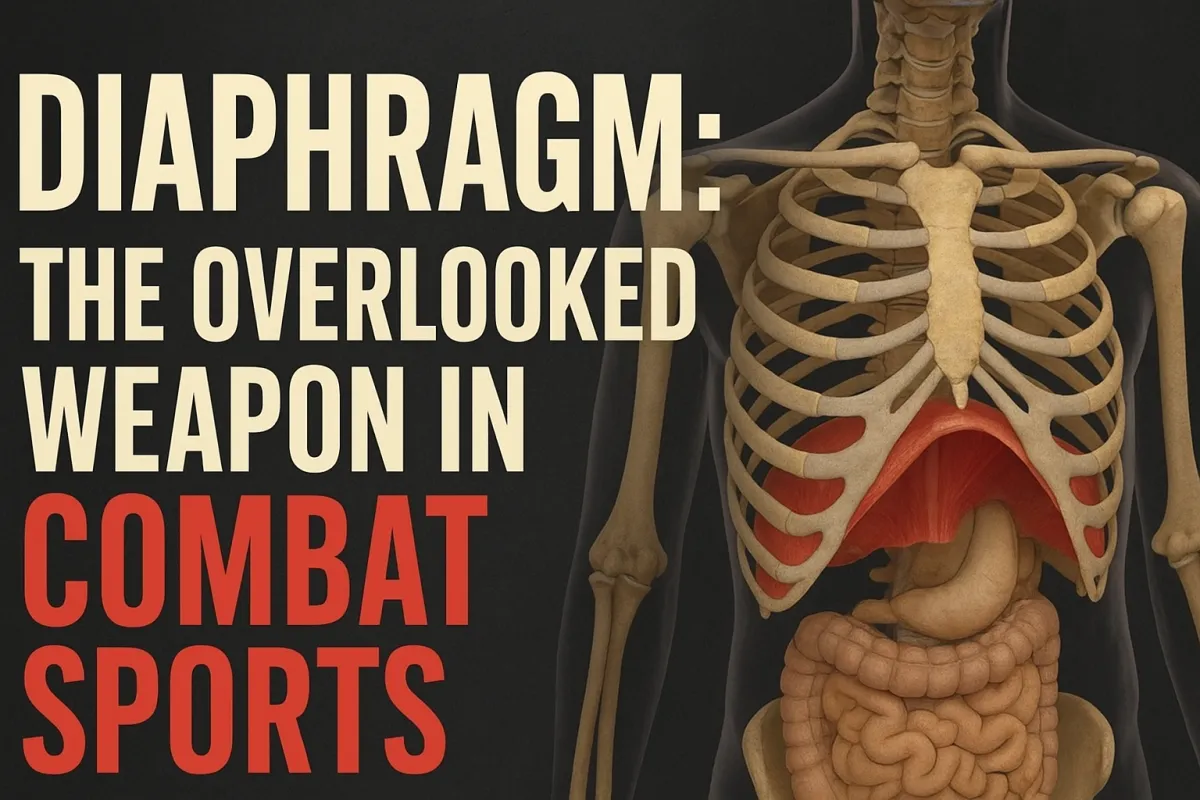
The Diaphragm: Breathing Muscle, Postural Powerhouse
In combat sports, the diaphragm is often reduced to one job: fueling breathing during intense training and competition. Fighters think of it as the muscle that pulls air into the lungs so they can last longer in sparring or recover faster between rounds. While that’s true, the diaphragm does much more. It’s not just a respiratory muscle. it’s also a postural muscle that plays a critical role in spinal stability, intra-abdominal pressure, and overall performance.
When fighters learn to control their diaphragm, they unlock better movement, more efficient oxygen use, and stronger core stability. Let’s break down why this overlooked muscle is a cornerstone of both performance and injury prevention.
The Diaphragm’s Dual Function
The diaphragm is a dome-shaped sheet of muscle that sits under the lungs and attaches to the lower ribs, spine, and sternum. It contracts downward when you inhale, drawing air into the lungs. On the surface, it seems like its job is simple: help you breathe. But because of where it attaches and how it interacts with surrounding muscles, it’s also a stabilizer.
When the diaphragm contracts properly, it creates intra-abdominal pressure (IAP)—the pressurization inside the trunk that supports the spine. This pressure is like an internal weight belt, giving fighters the ability to absorb impact, transfer force, and maintain posture under stress.
Breathing and Posture Are Connected
Every breath is a postural event. If your diaphragm is working properly, it not only brings in oxygen but also aligns your spine and ribcage for optimal mechanics. If it’s dysfunctional, you’ll see poor posture, collapsed ribs, or overactive accessory breathing muscles (like the neck and shoulders).
For fighters, poor diaphragmatic control often shows up as:
Gassing out faster due to shallow breathing
Overreliance on the neck and chest to breathe, leading to tension and fatigue
Reduced spinal stability, which increases injury risk
Limited rotational power in strikes and takedowns
By contrast, proper diaphragmatic breathing enhances both energy efficiency and movement efficiency—two things every combat athlete needs.
Why Combat Athletes Need Diaphragmatic Control
Spinal Alignment and Core Stability
Combat athletes take constant rotational and compressive forces. Every punch, kick, sprawl, and throw puts torque through the spine. The diaphragm works with the deep core (transverse abdominis, pelvic floor, multifidus) to stabilize the trunk against these forces. If it’s not firing correctly, your spine loses its natural “bracing” system, increasing the chance of back pain or injury.Oxygen Efficiency
Diaphragmatic breathing recruits more lung volume, especially the lower lobes where blood flow is greatest. This improves gas exchange, meaning more oxygen delivered to working muscles and more carbon dioxide removed. Fighters who breathe shallowly through the chest tire quicker because they’re not exchanging gases efficiently.Intra-Abdominal Pressure for Power Transfer
Every explosive strike or grappling exchange depends on force transfer from the ground up. The diaphragm’s ability to create and regulate intra-abdominal pressure gives athletes a stable foundation to push, pull, twist, and absorb hits.Stress and Recovery Regulation
The diaphragm is also a gateway to the parasympathetic nervous system (rest and recovery). Slow, controlled breathing stimulates the vagus nerve, reducing fight-or-flight overload and speeding recovery after high-intensity training or competition.
Practical Training for the Diaphragm
Combat athletes don’t need fancy tools to train their diaphragm, they need awareness and progressive integration.
1. Supine 90-90 Breathing
Lie on your back, hips and knees bent at 90 degrees, feet against a wall
Place one hand on your chest, the other on your belly
Inhale through your nose, focusing on expanding your belly and sides, not your chest
Exhale fully, feel ribs come down
5 minutes daily to reset breathing mechanics
2. Crocodile Breathing
Lie face down with forehead on your hands
Inhale and try to push your stomach into the ground
Great for athletes who default to chest breathing
3. Loaded Carries (Farmer’s or Suitcase Carries)
Force the diaphragm to work under load, stabilizing posture and breath simultaneously
4. Breathing with Movement
Integrate diaphragmatic control into striking drills, sprawls, and grappling
Focus on exhaling with force output and recovering with deep nasal inhales
5. Recovery Breathing
After sparring, sit upright, close your mouth, inhale slowly through your nose for 4 seconds, exhale for 6–8 seconds
This activates the parasympathetic nervous system and speeds recovery
Mistakes Fighters Make
Mouth Breathing Under Stress: Leads to shallow chest breathing, higher heart rates, and faster fatigue
Neglecting Core-Bracing Role: Thinking of the diaphragm only as a breathing muscle, not as part of the trunk stabilizer system
Overusing Accessory Muscles: Relying too much on the neck and shoulders to breathe, which creates tension and reduces efficiency
The Performance Payoff
When fighters train diaphragmatic control, they notice:
Improved cardio capacity (lasting longer in rounds)
Stronger core and fewer back issues
Better strike mechanics through stable spinal alignment
Faster recovery between rounds and after training
Greater mental calm under pressure
The diaphragm is more than just a breathing muscle, it’s a postural powerhouse. For combat athletes, mastering diaphragmatic control means improving oxygen efficiency, spinal stability, and energy transfer. It’s the hidden link between endurance, power, and injury prevention.
If you want to breathe better, move better, and fight better, train your diaphragm like you would any other muscle. Every breath is a chance to reinforce posture, fuel performance, and sharpen recovery.
References
Hodges, P. W., & Gandevia, S. C. (2000). Activation of the human diaphragm during a repetitive postural task. The Journal of Physiology, 522(1), 165–175.
Kolar, P., Neuwirth, J., Sanda, J., Suchanek, V., Svata, Z., Volejnik, J., & Pivec, M. (2012). Analysis of diaphragm movement during tidal breathing and during its activation while breath holding using MRI synchronized with spirometry. Physiological Research, 61(5), 513–526.
McKeown, P. (2015). The Oxygen Advantage: Simple, Scientifically Proven Breathing Techniques to Help You Become Healthier, Slimmer, Faster, and Fitter. HarperCollins.
Bordoni, B., & Marelli, F. (2016). The diaphragm in the pathophysiology of posture. Journal of Multidisciplinary Healthcare, 9, 281–291.
