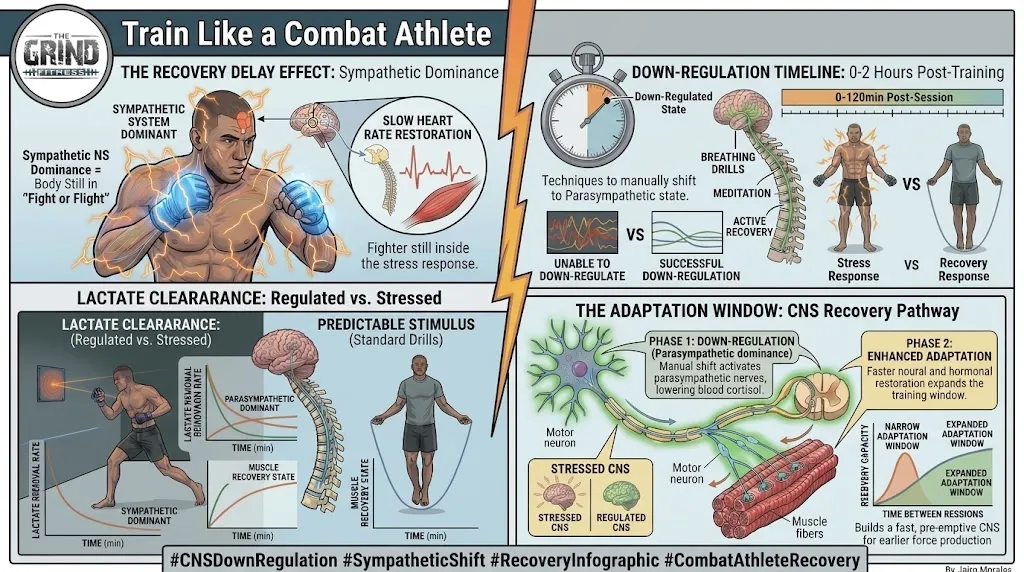
If You Cannot Down-Regulate After Hard Training, You Are Not Recovering. You Are Still Fighting.
By Jairo Morales | Train Like a Combat Athlete
Most combat athletes think about recovery as something that happens automatically when training stops. You finish the session. You go home. You sleep. The body repairs itself. You come back tomorrow ready to go again.
That is not how recovery works. And for a significant portion of combat athletes, the process that drives real adaptation between sessions is being compressed, delayed, or blocked entirely by a nervous system that never got the signal that the session was over.
The culprit is sympathetic nervous system dominance during recovery periods. And it is quietly robbing fighters of the adaptation they are working extremely hard to earn.
Two Systems. One Controls the Training. The Other Controls What Comes After.
The autonomic nervous system operates through two branches that govern how the body responds to stress and how it recovers from it.
The sympathetic nervous system is the branch that activates during training.The sympathetic nervous system dominates the regulation of body functions during exercise, raising heart rate, increasing cardiac output, directing blood flow to working muscles, and elevating respiration to support performance output.This is the system that makes training possible. Without it, the body cannot produce the force, speed, or endurance that combat sports demand.
The parasympathetic nervous system is the recovery branch. After training ends, the sympathetic nervous system withdraws and the parasympathetic nervous system helps the body return to a resting state, lowering heart rate through vagal reactivation and restoring autonomic homeostasis.This shift from sympathetic to parasympathetic dominance is not just a return to baseline. It is the physiological environment in which adaptation actually occurs: protein synthesis, glycogen replenishment, tissue repair, and the hormonal processes that convert training stress into improved capacity.
The problem for combat athletes is that this shift is not guaranteed. It does not happen automatically the moment the session ends. It requires the nervous system to receive clear signals that the stress period is over and the recovery period has begun. For a fighter whose lifestyle, training schedule, or post-session habits keep the sympathetic system activated, that signal never arrives.
What Happens When the Shift Does Not Happen
Post-exercise, the sympathetic nervous system continues its dominance, supporting immediate physiological recovery processes including replenishing oxygen stores, resynthesizing phosphocreatine, metabolizing stress hormones, and clearing lactate from the working muscles. For a brief window immediately after hard training, sympathetic dominance serves a purpose. It is driving the acute recovery processes that the body needs in the first minutes after a session ends.
But that window has a time limit. By five minutes post-exercise, most heart rate variability parameters show partial recovery indicating the initiation of autonomic balance, with a gradual restoration reflecting a shift from sympathetic dominance toward parasympathetic reactivation. When this shift is delayed or incomplete, the consequences accumulate across three separate physiological systems.
Heart rate stays elevated, which means the cardiovascular system remains in a work state rather than a recovery state. Lactate clearance slows, because improved recovery is characterized by reductions in heart rate, blood pressure, respiratory rate, and blood lactate concentration during the recovery period following exercise, and these reductions are directly linked to parasympathetic reactivation. When the parasympathetic branch is slow to engage, lactate remains in the system longer, the metabolic environment stays acidic, and the tissues that need to begin repairing are operating in a compromised environment.
The adaptation window between sessions compresses. This is the most significant consequence for a combat athlete with a high training frequency. The window in which the body converts the stress of a session into an actual performance improvement requires parasympathetic dominance to be established and sustained. Adequate recovery supports favorable adaptation, whereas impaired recovery may signal or contribute to maladaptation. A fighter who trains twice a day or on consecutive days without the parasympathetic shift occurring adequately between sessions is accumulating stress without accumulating adaptation. The training load is going up. The adaptive return is going down.
Why Combat Athletes Are Especially Vulnerable to This Problem
Systematic heart rate variability monitoring before and after intense workouts can help practitioners adjust training intensity based on each athlete's recovery capacity, with high-volume training significantly increasing sympathetic drive during recovery.
Combat athletes face a specific compounding problem that other athletes do not. The training environment itself keeps the sympathetic system activated. Sparring is a threat stimulus. The nervous system does not distinguish between a training round and a real fight. The competitive, high-stakes environment of a sparring session, even a controlled technical session, produces sympathetic activation that is qualitatively different from what a strength session or a conditioning bike produces.
A fighter who spars in the evening, leaves the gym still mentally in the session, scrolls through his phone, eats late, and tries to sleep while his nervous system is still processing the sparring environment is spending his supposed recovery time inside the stress response. When training load overwhelms recovery, parasympathetic dominance gives way to sympathetic overactivity: heart rate rises, heart rate variability drops, and baroreflex control weakens. Over days and weeks, this pattern produces a fighter who trains consistently but adapts poorly, who accumulates fatigue without accumulating the fitness that fatigue is supposed to purchase.
How to Train the Down-Regulation Response
The good news is that parasympathetic reactivation is trainable, and the behaviors that accelerate it are accessible to any combat athlete regardless of equipment or resources.
Athletes participating in mindfulness or resting practices immediately after training exhibited lower heart rates and respiratory rates and higher heart rate variability compared to those who resumed usual post-training activities, with the mindfulness and rest groups achieving a larger proportion of recovery compared to the no-intervention group. The practice does not need to be elaborate. Ten minutes of deliberate stillness immediately after training, lying down, controlling the breath, removing stimulation, signals the nervous system that the stress period is over and the recovery period has begun.
Breathing protocols are among the most direct tools available for initiating parasympathetic reactivation. Extended exhale breathing, where the exhale is twice the length of the inhale, directly stimulates the vagus nerve and accelerates the shift from sympathetic to parasympathetic dominance. Four seconds in, eight seconds out, repeated for five to ten minutes immediately post-session, produces measurable reductions in heart rate and subjective stress that facilitate the earlier onset of the recovery process.
Low-intensity exercise at heart rate below 140 beats per minute induces minimal perturbation of sympathovagal balance, primarily characterized by parasympathetic dominance, with HRV indices returning to baseline within minutes, indicating rapid restoration of autonomic homeostasis.This means a ten to fifteen minute low-intensity cooldown walk or easy bike immediately after hard training actively accelerates the parasympathetic shift rather than simply passing time.
Sleep environment and timing matter directly. The sympathetic system is sensitive to light, screen exposure, and cognitive stimulation. A fighter who wants to maximize the adaptation window between an evening session and the next morning's training needs to create conditions that allow parasympathetic dominance to establish itself: low light, no screens, a cool environment, and a consistent sleep schedule that the nervous system can anticipate.
The Adaptation Window Is Earned, Not Given
Hard training creates the stimulus for adaptation. Recovery is where that stimulus gets converted into actual improvement. The two are not interchangeable, and one does not guarantee the other.
A fighter who trains hard but keeps his sympathetic system activated through the recovery period is doing the stimulus work without doing the conversion work. His training sessions are producing stress. His body is not having the physiological environment it needs to turn that stress into a better fighter.
Endurance-trained athletes have accelerated heart rate recovery after exercise, and heart rate recovery provides a valid marker for training-induced disturbances in autonomic control and useful information for training prescription. The capacity to shift rapidly from sympathetic to parasympathetic dominance after hard training is itself a trainable quality that improves with consistent aerobic base development and deliberate recovery practices.
The fighter who cannot down-regulate after hard training is spending his recovery time still inside the stress response. The adaptation window is open. He is just not inside it.
Deliberately close the session. Deliberately initiate recovery. The body adapts in the window between training sessions, and that window only opens when the nervous system is finally allowed to shift.
Want a structured 180-day program that addresses mobility, strength, power, and athletic performance in the correct sequence for combat sports? Book a free strategy call with Jairo today.
Sources
Frontiers in Physiology. Autonomic Nervous System Recovery Dynamics Following Resistance Training. June 2025. https://www.frontiersin.org/journals/physiology/articles/10.3389/fphys.2025.1579929/pdf
ResearchGate. Autonomic Recovery after Exercise in Trained Athletes. https://www.researchgate.net/publication/6078672_Autonomic_Recovery_after_Exercise_in_Trained_Athletes
Frontiers in Sports and Active Living. New Perspectives and Insights on Heart Rate Variability in Exercise and Sports. 2025. https://www.ncbi.nlm.nih.gov/pmc/articles/PMC11897043/
PMC. Effect of Training Mode on Post-Exercise Heart Rate Recovery of Trained Cyclists. 2014. https://www.ncbi.nlm.nih.gov/pmc/articles/PMC4120463/
Nature Scientific Reports. Post-Exercise Auricular Vagus Nerve Stimulation Modulates Autonomic and Recovery Responses. 2026. https://www.nature.com/articles/s41598-026-47143-z
Frontiers in Sports and Active Living. Post-Exercise Mindfulness and Rest Accelerate Parasympathetic Reactivation. 2023. https://www.frontiersin.org/journals/sports-and-active-living/articles/10.3389/fspor.2023.1267631/xml
ResearchGate. Autonomic Control of Heart Rate During and After Exercise. https://www.researchgate.net/publication/271925706_Autonomic_Control_of_Heart_Rate_during_and_after_Exercise
PMC. Monitoring Training Adaptation and Recovery Status in Athletes Using Heart Rate Variability via Mobile Devices. December 2025. https://www.ncbi.nlm.nih.gov/pmc/articles/PMC12787763/
BioRxiv. Cardiometabolic Recovery and Lactate Removal May Be Related to Muscular Adaptations. https://www.biorxiv.org/content/10.1101/402511.full.pdf
Institute of Motion. Autonomic Recovery after Exercise in Trained Athletes: Intensity and Duration Effects. https://instituteofmotion.com/wp-content/uploads/2021/01/Autonomic-Recovery-after-Exercise-in-Trained-Athletes-intensity-and-duration-effects-S-Seiler.pdf
