Your Nervous System Moves Before You Do. Here Is How to Train It.
By Jairo Morales | Train Like a Combat Athlete
The fastest athletes in combat sports are not reacting faster than their opponents. They are preparing faster.
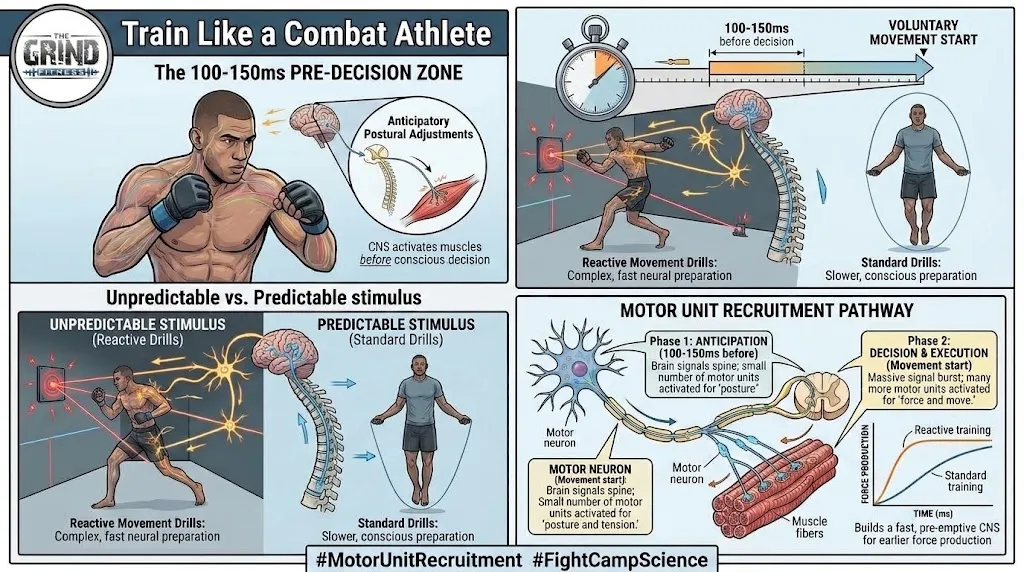
There is a mechanism operating in every explosive movement that most fighters have never heard of and almost none are deliberately training. It activates 100 to 150 milliseconds before a voluntary movement begins. It prepares the body for force production before the conscious decision to move has even been fully processed. And it is the difference between a fighter whose body is already organized for the next exchange and one whose body is still catching up to what his brain decided to do.
It is called an anticipatory postural adjustment. And it is entirely trainable.
What an Anticipatory Postural Adjustment Actually Is
When a person performs a rapid action, such as flexing an arm or initiating an explosive movement, the postural muscles in the trunk and legs become active approximately 50 to 150 milliseconds before the primary muscles of the limb itself begin firing. This preparatory activation is called an anticipatory postural adjustment, and it is a feedforward mechanism, a pre-emptive strike against instability that the nervous system executes before conscious awareness of the movement has been fully processed.
Anticipatory postural adjustments are typically seen starting about 100 milliseconds prior to the initiation of voluntary action.</cite> This means the nervous system is not waiting for the movement to begin before it starts preparing for the consequences of that movement. It is projecting forward, predicting the postural disruption the movement will cause, and pre-loading the stabilizing structures to handle it before the disruption arrives.
The round trip for a signal to travel from muscles to the brain and back again, including processing time and the delay for a muscle to generate force, can take upwards of 70 to 120 milliseconds or more. For a fast, powerful movement, by the time a reactive correction is underway, the athlete might already be irrecoverably off-balance.This is why the body developed the anticipatory system in the first place. Reactive correction is too slow for high-velocity movement. The nervous system has to prepare the body before the movement begins or the movement cannot be executed with precision and power.
For a combat athlete, this mechanism is operating in every takedown entry, every punch, every sprawl, every level change, and every explosive scramble. The quality of that preparation determines whether the movement is crisp and powerful or disorganized and weak.
Why This Changes Everything About How You Should Train
Most combat athletes train explosive movement from a predictable, prepared starting position. The signal to move is known. The direction is anticipated. The body has time to consciously organize before the movement begins.
That is not how combat sports work.
In a real fight, the stimulus to move is unpredictable. An opponent shoots a takedown. A scramble breaks open in a direction neither athlete planned. A counter opportunity appears and disappears in a fraction of a second. The fighter who responds to these moments with a well-organized, powerful movement is the one whose nervous system has learned to generate anticipatory postural adjustments rapidly and accurately under conditions of uncertainty.
The nervous system only recruits muscles at speeds for which it has been trained. If the nervous system has not been trained to recruit muscles quickly in response to an unpredictable stimulus, when met with a demand that requires a fast reaction, the nervous system will not be able to respond appropriately.
This is the core of the training argument. A fighter who only practices explosive movements from predictable setups is training the nervous system to organize itself when it already knows what is coming. The fight never gives him that luxury. Unpredictable change of direction distinguishes reactive agility from non-reactive agility, requiring neuromuscular coordination, reaction time, stimulation of neural neurons, muscle fiber recruitment, and faster nerve firing.These are the qualities that determine who wins the first exchange in a scramble, not maximum strength or conditioning alone.
How Reactive Training Builds Anticipatory Capacity
Whole-body reaching training repeated over consecutive days induced not only improvements in motor performance, including increased peak movement velocity, but also changes in anticipatory postural adjustments, specifically earlier APA onset and increased amplitude.This tells you the mechanism is trainable. Consistent exposure to movement under reactive conditions changes the timing and magnitude of anticipatory preparation. The nervous system learns to fire earlier and organize more completely before the movement begins.
Reactive training teaches the nervous system to recruit muscles quickly, thus enhancing the rate at which muscles generate force. Reactive success is based on both the speed of interpreting the stimulus and the speed of executing the response. The sensory motor system determines the current state of the body at the time of receiving the stimulus, determines the rate at which needed muscles fire in harmony with other involved muscle groups, and simultaneously ensures deeper stabilizing muscles provide the necessary joint stability for the required force production.
For a combat athlete, this means the training environment has to include movement initiated under unpredictable stimulus. Not just drilling takedown entries from a set position. Not just running predetermined agility patterns. The stimulus has to be variable, the direction has to be uncertain, and the movement has to be initiated reactively for the adaptation to occur.
The amplitude and duration of anticipatory postural adjustments are scaled linearly to the kinetic energy and work demands of the forthcoming voluntary movement.This means the more powerful the intended movement, the larger and earlier the anticipatory preparation needs to be. A fighter training exclusively at submaximal intensities in predictable patterns is not developing the full anticipatory response that maximal explosive movements in chaotic situations demand.
What Reactive Training Looks Like in Practice
The training environments that develop anticipatory postural adjustment capacity share a common element: the athlete does not know exactly what is coming or when.
Partner-initiated reactive drills are among the most effective tools available. A training partner initiates a takedown shot, a level change, or a direction change at an unpredictable moment, and the athlete responds with a predetermined action, a sprawl, a redirect, a counter entry. The unpredictability of the initiation is the entire point. The nervous system has to generate its anticipatory preparation based on reading the stimulus, not on knowing in advance what it needs to do.
Light-based reactive agility systems, random-direction cone drills with visual cues, and band-resisted movement drills where the resistance direction varies all place the same fundamental demand on the nervous system: generate organized, powerful movement in response to an external stimulus that was not anticipated in advance.
Reactive training teaches reactive stabilization at various joints, maintains postural equilibrium at faster speeds, and utilizes proper mechanics to increase force production when needed. It is critical to train at speeds functionally applicable to the demands of the sport.
The speed requirement is important. Slow reactive drills at moderate intensity do not develop the rapid anticipatory preparation that high-velocity combat situations demand. The training stimulus must approach the speed and intensity of competition for the nervous system to develop the anticipatory capacity that competition requires.
Plyometric work done under reactive conditions, meaning initiated by a signal rather than self-timed, also contributes directly to this adaptation. The combination of explosive force demands and reactive initiation forces the nervous system to generate both the anticipatory postural adjustment and the movement itself under the time pressure that competition creates.
The Fighter Who Prepared His Nervous System
Two fighters of equal technical skill and physical conditioning enter a scramble. One has trained explosive movement almost exclusively from predictable, self-initiated positions. The other has spent months training reactive movement under variable, unpredictable stimulus.
In the scramble, the first fighter is organizing reactively. His body is catching up to what his brain told it to do. His anticipatory preparation is delayed because his nervous system has only learned to generate it from known starting conditions.
The second fighter's nervous system reads the stimulus and fires the anticipatory preparation before the conscious decision to move has been fully processed. His body is already organized for force production when the movement begins. His response is faster, more powerful, and more structurally sound.
Same technique. Same conditioning. Different nervous system preparation.
The body prepares for force production before the conscious decision to move is made. Train the system that handles that preparation under unpredictable conditions, or every scramble will find you a fraction of a second behind the athlete who did.
Want a structured 180-day program that addresses mobility, strength, power, and athletic performance in the correct sequence for combat sports? Book a free strategy call with Jairo today.
Sources
PMC. Anticipatory Postural Adjustments and Anticipatory Synergy Adjustments: Preparing to a Postural Perturbation with Predictable and Unpredictable Direction. 2017. https://pmc.ncbi.nlm.nih.gov/articles/PMC5316309/
PMC. Two Aspects of Feedforward Postural Control: Anticipatory Postural Adjustments and Anticipatory Synergy Adjustments. 2011. https://pmc.ncbi.nlm.nih.gov/articles/PMC3094180/
ScienceDirect. Anticipatory Postural Adjustment for Compensating Forces and Moments Associated with Isometric Force Production in an Upper Limb. 2025. https://www.sciencedirect.com/science/article/abs/pii/S0021929025004737
ScienceDirect. Anticipatory Postural Adjustments Depend on Final Equilibrium and Task Complexity in Vertical High Jump Movements. https://www.sciencedirect.com/science/article/abs/pii/S1050641100000067
PubMed. Are Amplitude and Duration of Anticipatory Postural Adjustments Identically Scaled to Focal Movement Parameters in Humans? https://pubmed.ncbi.nlm.nih.gov/10653016/
Bohrium Science Encyclopedia. Anticipatory Postural Adjustments: Principles and Mechanisms. https://www.bohrium.com/en/sciencepedia/feynman/keyword/anticipatory_postural_adjustments
ACE Fitness. Incorporating Reactive Training Into Your Clients Exercise Programs. June 2020. https://www.acefitness.org/continuing-education/certified/june-2020/7559/incorporating-reactive-training-into-your-clients-exercise-programs/
DotFit. What Is Reactive Training and Why Should I Do It? https://www.dotfit.com/content-1456.html
Brieflands. A Review of Reactive and Non-Reactive Agility Tests Concerning Neurologic Aspects. https://brieflands.com/journals/thrita/articles/129744
PMC. Application of a Reactive Agility Training Program Using Light-Based Stimuli to Enhance Physical and Cognitive Performance. 2022. https://www.ncbi.nlm.nih.gov/pmc/articles/PMC9445110/
