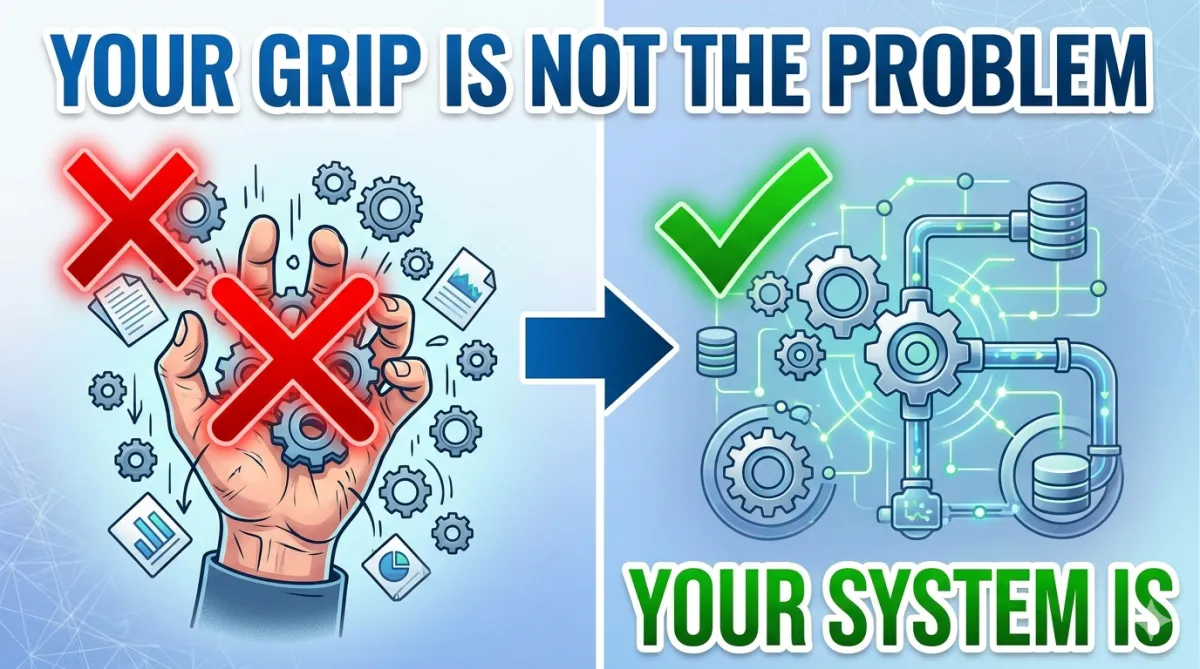
Your Grip Is Not the Problem
Your Grip Is Not the Problem. Your System Is.
By Jairo Morales | Train Like a Combat Athlete
You are in the final round. Your technique is sharp. Your cardio is holding. But your hands will not close the way they did in round one. The grip that felt locked in at the start of the fight is now slipping, releasing, failing at exactly the moment you need it most.
Most fighters blame weak hands. They go home and order a grip trainer. They squeeze a rubber ball for three weeks and wonder why nothing changes.
Here is the truth most coaches will not tell you: grip failure in the final round is not a hand strength problem. It is a forearm flexor endurance problem built on top of a systemic fatigue problem. And if you keep training the symptom instead of the system, nothing will change.
What Is Actually Happening When Your Grip Fails
Your grip is controlled primarily by two muscle groups in your forearm: the flexor digitorum superficialis and the flexor carpi radialis. These muscles contract repeatedly and continuously throughout every grappling exchange, every clinch, every collar tie, every submission attempt. They do not get rest unless you create it.
The problem is not that these muscles are weak. In most trained combat athletes, raw grip strength is adequate. The problem is how long they can sustain force output under accumulating fatigue, which is a completely different quality than maximum strength.
Research on Brazilian Jiu-Jitsu athletes confirms this. Studies measuring forearm flexor performance across repeated matches show that maximum voluntary isometric contraction in the forearm flexors begins declining after the first match and continues declining with each subsequent round, with peripheral fatigue in the muscle contractile function being the primary driver. By the time an athlete reaches the final round of a training session or competition, the forearm flexors are operating at a significantly reduced capacity regardless of how strong they tested fresh.
This is forearm flexor endurance failure. Not grip weakness.
Why Systemic Fatigue Makes It Worse
Here is where most athletes miss the second layer of the problem.
When your body reaches a high level of systemic fatigue, your central nervous system begins downregulating output to protect itself. This is not a weakness. It is a built-in regulatory mechanism. But the consequence for a combat athlete is that your nervous system starts reducing the signal it sends to your muscles, including your forearm flexors, before those muscles have actually reached their own limit.
This means your grip is failing not just because your forearms are fatigued, but because your entire system is fatigued and your nervous system is pulling resources away from the extremities to protect higher-priority functions.
Research on neuromuscular fatigue in combat sports athletes shows that post-match impairments in muscle contractile function are primarily peripheral in nature. Your forearm flexors are not just getting tired. They are accumulating metabolic byproduct buildup, experiencing reduced blood flow efficiency during sustained contractions, and losing firing rate capacity as the round progresses.
The forearms are the most exposed endpoint of a fully taxed system. When everything above them is already under stress, the grip is the first thing to go.
The Wrong Fix and the Right One
The wrong fix is isolated grip training done fresh, outside of the context of combat fatigue. Squeezing a gripper for sets of 20 while sitting at your desk builds maximum grip strength in a rested state. That is not the problem you have. The problem you have is grip endurance under accumulated full-body fatigue late in a fight.
The right fix operates at two levels.
Fix the system first.
Your forearm flexors will hold longer when the system feeding them is less fatigued. This means building a stronger aerobic base so your body clears metabolic waste more efficiently during rest periods between exchanges. It means developing work capacity across your upper body, shoulders, and back so those structures are not already compromised by the time a grip-intensive exchange begins. A fighter with a strong aerobic engine and well-conditioned posterior chain will always have better late-round grip than a fighter of equal forearm strength who lacks that foundation.
Then train flexor endurance in context.
Once the systemic base is in place, forearm flexor endurance training must be trained under fatigue, not fresh. The adaptation you need is the ability of those muscles to sustain contractile force when metabolic byproducts have accumulated and blood flow is partially restricted by sustained contraction.
Practical tools include dead hangs and towel hangs held for extended durations at the end of sessions, rope climbing done for multiple sets late in training, and gi-grip drills performed in the final rounds of practice when the forearms are already taxed. The training environment must replicate the fatigue context of competition. Anything less trains a quality you will never need.
High-rep farmer carries with a thick bar or rope handle, done in moderate duration sets with incomplete rest, are among the most transferable tools available. They force the forearm flexors to sustain output against blood flow restriction while the rest of the body is already under systemic load. This is the environment that produces real late-round grip.
What the Final Round Actually Reveals
The final round does not test your grip. It tests everything that came before it.
Your aerobic capacity determines how much metabolic stress your forearms are absorbing from the rest of your body. Your posterior chain and shoulder endurance determine how much mechanical load your forearms are inheriting from structures above them. Your overall work capacity determines how much your nervous system has already dialed down output before your forearms ever reach their own limit.
When you fix the system, the forearm flexors do not have to fight so hard to stay functional. They are not compensating for a gassed engine. They are the final link in a chain that is still running efficiently, and that makes all the difference.
The grip does not fail in the final round because your hands are weak. It fails because everything behind the hands gave out first.
Fix the system. The grip holds itself.
Want a 180-day program built to develop elite-level strength, endurance, and performance for combat sports from the system up? Book a free strategy call with Jairo today.
Sources
Virgile A, Bishop C. Neuromuscular Fatigue During Brazilian Jiujitsu Matches: Analysis of Upper and Lower Limbs. PubMed. October 2024. https://pubmed.ncbi.nlm.nih.gov/39467539/
Lopes-Silva JP, et al. Does Grappling Combat Sports Experience Influence Exercise Tolerance of Handgrip Muscles in the Severe-Intensity Domain? PMC. 2024. https://www.ncbi.nlm.nih.gov/pmc/articles/PMC10974517/
Adamczyk JG, et al. Comparing The Effects of Compression Contrast Therapy and Dry Needling on Muscle Functionality Following Forearm Muscle Fatigue in Combat Sports Athletes. PubMed. September 2024. https://pubmed.ncbi.nlm.nih.gov/39228772/
Bauer P, et al. Effects of Forearm Compression Sleeves on Muscle Hemodynamics and Muscular Strength and Endurance Parameters in Sports Climbing. PMC. 2022. https://www.ncbi.nlm.nih.gov/pmc/articles/PMC9206081/
Olivier N, et al. Recovery and Fatigue Behavior of Forearm Muscles during a Repetitive Power Grip Gesture in Racing Motorcycle Riders. International Journal of Environmental Research and Public Health. July 2021. https://www.mdpi.com/1660-4601/18/15/7926
MacDonald M. Handgrip Fatigue and Forearm Girth in Intermediate Sport Climbers. UNLV Theses and Dissertations. https://oasis.library.unlv.edu/context/thesesdissertations/article/4369/viewcontent/MacDonald_unlv_0506M_12751.pdf
O'Dowd DP, et al. Forearm compartment pressures and grip strength in elite motorbike racers with chronic exertional compartment syndrome. Journal of Orthopaedic Surgery and Research. October 2021. https://www.ncbi.nlm.nih.gov/pmc/articles/PMC8518181/
Evolve MMA. What Is Muscle Fatigue And How To Recover From It. February 2024. https://evolve-mma.com/blog/what-is-muscle-fatigue-and-how-to-recover-from-it/
BJJ Eastern Europe. 1st Match Adrenaline Dump and Forearm Burnout: Why It Happens and How to Deal with It. May 2020. https://www.bjjee.com/articles/1st-match-adrenaline-dump-forearm-burnout-happens-deal/
