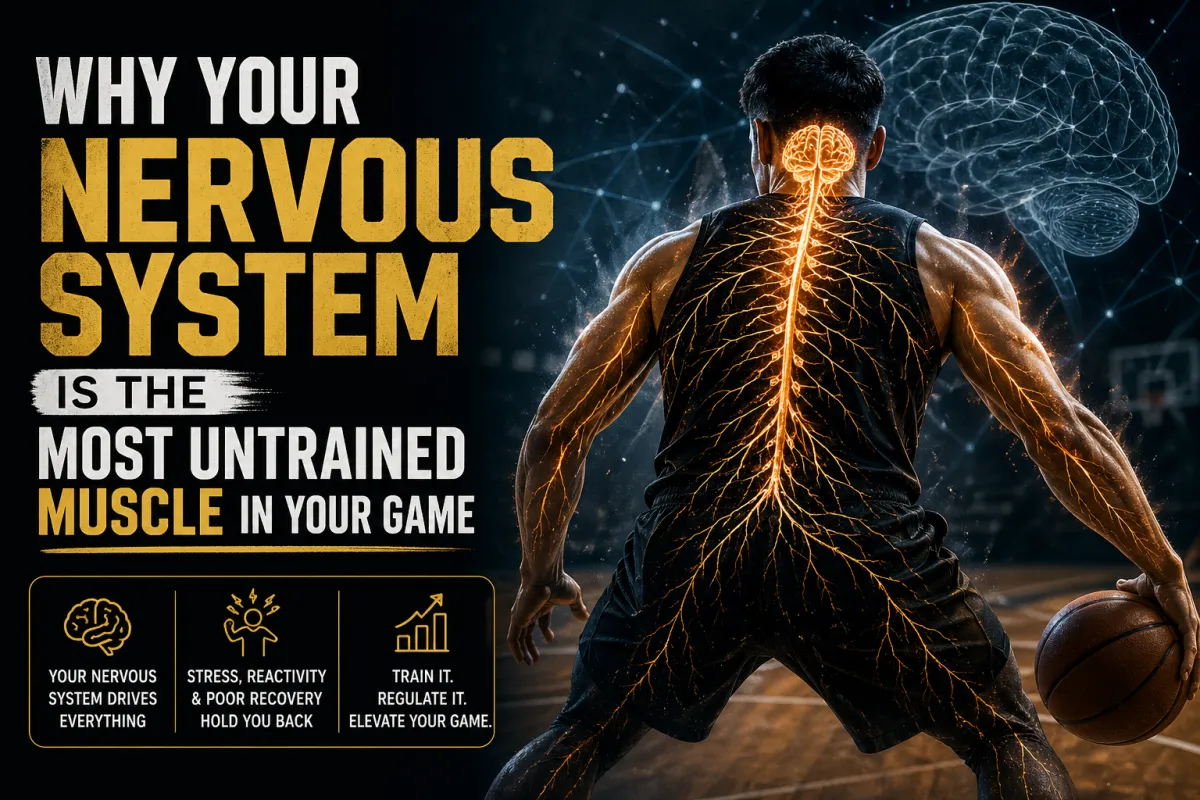
Why Your Nervous System Is the Most Untrained Muscle in Your Game
By Jairo Morales | Train Like a Combat Athlete
You've been in the gym. You've put in the rounds. You lift, you drill, you condition. But when it counts, when the round is deep and your opponent is still moving, something breaks down.
Your power disappears. Your shots slow. Your grip weakens.
Most athletes blame their lungs. Some blame their legs. Almost none of them blame the real culprit:
The nervous system.
Specifically, a mechanism called rate coding and if you've never trained for it, you're leaving a significant amount of your athletic potential on the table.
What Is Rate Coding?
Every time your muscle contracts, your brain sends an electrical signal through your motor neurons to the muscle fibers they control. A motor unit is the motor neuron plus all the muscle fibers it activates. The number of motor units your brain recruits determines how much muscle you engage. But there's a second variable that most athletes never train:
How fast those motor units fire.
That firing frequency is rate coding.
Think of it this way: a motor unit firing at a low frequency produces a small twitch. When the firing rate increases, those twitches stack on top of each other , a phenomenon called summation and force production skyrockets. At peak firing rates, the muscle reaches what's called fused tetanus: a maximal, sustained contraction where force output is magnified well beyond what normal, slow recruitment produces.
The higher your rate coding capacity, the harder, faster, and more powerfully you can express force even without adding a single pound of muscle.
Why This Matters for Combat Sports
In combat sports, virtually every high-value action is explosive and brief:
A takedown entry
A knockout punch
An explosive guard pass
A reactive sprawl
These movements happen in fractions of a second. The athlete who wins these exchanges isn't always the strongest in the gym. They're the one whose nervous system fires motor units faster and more efficiently under pressure.
Research confirms this. Elite-level sprinters , athletes whose sport demands maximum rate of force development, show significantly higher motor unit firing frequencies than untrained individuals during rapid contractions. Rate coding, like motor recruitment, is a trainable skill. Your nervous system literally learns to fire faster with the right stimulus.
What's more, during a competition, your body naturally releases adrenaline , which directly amplifies rate coding. That's why athletes are often faster, stronger, and more explosive in actual fights than in training. The problem is that most athletes rely on adrenaline alone to access this capacity. The goal of proper training is to build that ceiling so the competition-day boost takes you even higher.
The Problem With Most Combat Athlete Training
Here's what typically happens: A fighter shows up to the gym and does circuit training. High reps, moderate weight, limited rest. Maybe some pad work, some drilling, maybe a few rounds. Everything is done in a fatigued state.
This builds work capacity. It does not train rate coding.
Slow, moderate, or fatigue-based training keeps motor unit firing frequencies low. You're training your body to survive — not to explode. Over time, this actually conditions your nervous system to be conservative with force output, which is the opposite of what a combat athlete needs.
The nervous system adapts specifically to the demands you place on it. If you never demand maximum rate of force development, you never build it.
How to Train Your Nervous System to Fire Faster
Two training tools are the most effective for developing rate coding in combat athletes.
Explosive Lifts
Movements like power cleans, hang cleans, trap bar jumps, and jump squats force your nervous system to recruit motor units rapidly and fire them at high frequencies. The intent to move fast is as important as the load itself. Research shows that training with rapid contractions increases both the rate of force development and the average discharge rate of motor units, changes that transfer directly to athletic performance.
The key is sub-maximal loads moved with maximal intent. You are not grinding through these reps. You are attacking them.
Sprints
All-out sprints, especially short-distance acceleration sprints of 10 to 30 yards are among the most effective neural training tools available. They demand that your nervous system recruit the highest-threshold motor units and fire them at peak frequency. They also train your body to produce force quickly from a dead stop, which mirrors the demands of combat sports more closely than almost any gym exercise.
Combined, these two modalities teach your nervous system to access and express force rapidly, the exact quality that separates an athlete who fires a sharp double-leg in the second round from one who stalls because their power has faded.
Programming It the Right Way
Rate coding training has one critical requirement: it must be done fresh.
Unlike conditioning work which intentionally stresses your system under fatigue, neural output training demands that your central nervous system is recovered and ready. Doing explosive lifts or sprints when you're already gassed defeats the purpose. You won't fire at the frequencies that produce the adaptation.
Here's a simple structure to implement this immediately. Dedicate two days per week to explosive neural output work. Start each session with your power work before sparring, before conditioning. Keep volumes low and intensities high: 3 to 5 sets, 2 to 5 reps per set, with full recovery between efforts ranging from 90 seconds to 3 minutes. Chase speed and intent, not load.
Over 8 to 12 weeks, this approach systematically raises your neural ceiling, more force, faster expression, and a body that doesn't fall apart when the fight gets deep.
The Bottom Line
Most combat athletes train their lungs. Some train their muscles. Very few train their nervous system.
Rate coding is the mechanism that determines how much of your strength, speed, and power you can actually access under pressure, when it matters, in the late rounds when your opponent is still coming.
Explosive lifts and sprints aren't accessories to your training. For a combat athlete serious about performing at their ceiling, they're the foundation.
Your nervous system can be trained. The question is whether you're training it or leaving it on the table.
Want a structured 180-day program built specifically to develop elite-level strength, power, and endurance for combat sports? [Book a free strategy call with Jairo →]
Sources
Enoka RM, Duchateau J. Rate Coding and the Control of Muscle Force. Cold Spring Harb Perspect Med. 2017 Oct 3;7(10):a029702. https://pmc.ncbi.nlm.nih.gov/articles/PMC5629984/
Van Dyke, Matthew. Rate of Force Development (RFD) and Co-activation. VanDyke Strength. https://vandykestrength.com/RFD_Adapt.pdf
Van Cutsem M, Duchateau J, Hainaut K. Changes in single motor unit behaviour contribute to the increase in contraction speed after dynamic training in humans. J Physiol. 1998;513:295–305.
Duchateau J, Baudry S. Maximal discharge rate of motor units determines the maximal rate of force development during ballistic contractions in human. Front Hum Neurosci. 2014;8:234.
Frontiers in Physiology. Neuromuscular adaptations to resistance training in elite versus recreational athletes. 2025. https://www.frontiersin.org/journals/physiology/articles/10.3389/fphys.2025.1598149/full
Human Kinetics. Neuromuscular Adaptations to Strength Training. https://us.humankinetics.com/blogs/excerpt/neuromuscular-adaptations-to-strength-training
The Sports Edu. Neural Adaptations to Strength Training. https://thesportsedu.com/neural-adaptations-to-strength-training/
TRAINFITNESS. Neuromuscular Efficiency for Enhancing Performance. 2025. https://train.fitness/personal-trainer-blogs/neuromuscular-efficiency-for-enhancing-performance
Higher-Faster-Sports. Rate Coding — The Psycho Factor. http://www.higher-faster-sports.com/psychofactor.html
