Why Tendon Adaptation Lags Behind Muscle Growth and How Fighters Get Injured Chasing Progress
In combat sports, one of the most dangerous mistakes athletes make is assuming that if their muscles are getting stronger, their bodies are fully prepared for more load.
They are not.
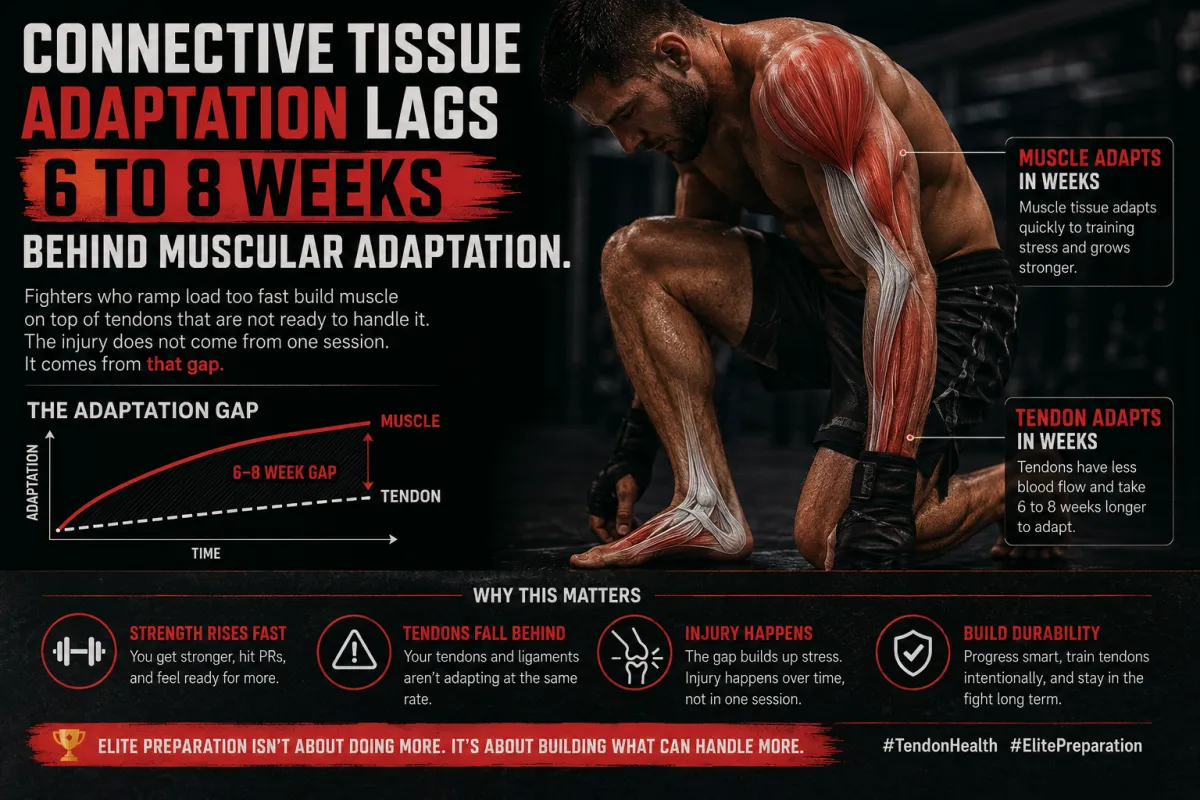
One of the most overlooked realities in strength and conditioning is that connective tissue adaptation lags significantly behind muscular adaptation. While muscles can become stronger and larger within a matter of weeks, tendons and ligaments require much longer to adapt to training stress.
For fighters, this creates a dangerous window where performance appears to be improving, but the structures responsible for transmitting force and stabilizing joints have not caught up.
The injury rarely comes from a single workout.
It comes from the gap.
The Difference Between Muscle and Tendon Adaptation
Muscle tissue is highly vascularized, meaning it receives a substantial blood supply. This allows muscles to recover and adapt relatively quickly to training stimuli.
Connective tissues such as tendons are different.
Tendons have significantly less blood flow, which means they remodel and strengthen at a much slower rate. Research suggests that meaningful tendon adaptation often trails muscular adaptation by approximately six to eight weeks.
This means a fighter may experience:
Increased strength
Improved work capacity
Faster recovery between sessions
Greater confidence in training
Yet their tendons may still be operating at their previous level of capacity.
The athlete feels ready.
The connective tissue is not.
This discrepancy creates the perfect environment for overuse injuries and tendon pathology.
Why Fighters Are Especially Vulnerable
Combat athletes place unique demands on their connective tissues.
Unlike traditional gym-goers, fighters constantly expose their bodies to explosive and unpredictable forces.
Every takedown attempt, scramble, punch, kick, sprawl, shot, grip exchange, and clinch battle places tremendous stress on tendons throughout the body.
Common areas include:
Patellar tendon
Achilles tendon
Rotator cuff tendons
Elbow tendons
Hip flexor tendons
Adductor tendons
The challenge is that combat athletes often measure readiness based on performance.
If they can lift heavier, train harder, and push through sessions, they assume adaptation is occurring everywhere equally.
Unfortunately, biology does not work that way.
Muscles may be progressing rapidly while connective tissue remains weeks behind.
The False Confidence Phase
One of the most dangerous periods in any training cycle occurs when muscular gains begin to accelerate.
The athlete starts hitting personal records.
Conditioning improves.
Training volume increases.
Coaches become excited.
The fighter feels unstoppable.
This is often the exact point where injury risk begins climbing.
Why?
Because improved muscular output allows the athlete to produce greater force than their connective tissues can currently tolerate.
Think of it like installing a high-performance engine into a vehicle while leaving the original suspension and brakes unchanged.
The engine is capable of producing more power, but the support structures have not been upgraded to handle it.
Eventually something breaks.
The same principle applies to the human body.
Tendon Injuries Are Usually Accumulation Problems
Many athletes point to one workout or one movement as the cause of their injury.
They say:
"My knee started hurting after that sprint session."
"My shoulder blew up during sparring."
"My elbow started hurting after deadlifts."
In reality, most tendon injuries develop over time.
The final session simply reveals a problem that has been building for weeks.
Connective tissue injuries are often the result of accumulated stress exceeding tissue capacity.
Each training session adds load.
Each hard sparring round adds load.
Each lifting workout adds load.
Each explosive repetition adds load.
When recovery and adaptation cannot keep pace with loading demands, the tissue gradually becomes compromised.
The injury was not created in one session.
It was created through repeated exposure without adequate progression.
The Importance of Intelligent Load Management
One of the primary responsibilities of a strength and conditioning coach is managing training load.
Elite preparation is not about pushing harder every week.
It is about exposing the body to stress at a rate it can successfully adapt to.
This requires patience.
The most successful fighters are not always the ones who train the hardest.
They are often the ones who progress the smartest.
Load management includes:
Gradual increases in volume
Strategic increases in intensity
Planned recovery periods
Monitoring fatigue
Respecting tissue adaptation timelines
Athletes who consistently rush this process often experience recurring injuries that derail long-term progress.
Building Stronger Tendons
The good news is that tendons respond positively to properly structured training.
They simply require time.
Several training methods can help improve tendon health and resilience:
Heavy Slow Resistance Training
Controlled resistance exercises performed through a full range of motion have been shown to stimulate tendon remodeling.
Examples include:
Split squats
Romanian deadlifts
Slow calf raises
Tempo squats
The goal is not speed.
The goal is tissue adaptation.
Isometric Training
Isometric exercises can improve tendon capacity while reducing pain and irritation.
Examples include:
Wall sits
Mid-thigh pull holds
Split squat holds
Isometric calf raises
These exercises are particularly useful during high-volume fight camps.
Progressive Exposure
Connective tissue thrives on consistent loading.
What it does not tolerate well is sudden spikes in workload.
Gradually increasing training stress allows tendons to remodel and strengthen without becoming overwhelmed.
Consistency beats intensity when it comes to long-term tendon health.
The Long-Term Athlete Wins
In combat sports, everyone wants rapid results.
Fighters want bigger numbers in the gym.
More explosive power.
Better conditioning.
Faster progress.
But the athletes who stay healthy year after year understand a critical truth.
Adaptation is not just about muscles.
It is about the entire system.
Muscles may improve quickly.
Connective tissue does not.
Ignoring this reality is one of the fastest paths to chronic injuries, missed training time, and stalled development.
The smartest fighters understand that preparation is not measured by how much work they can survive today.
It is measured by how much work they can consistently handle six months, one year, and five years from now.
Elite preparation requires patience.
Respect the biology.
Respect the timeline.
Build the tendons alongside the muscles.
Because when connective tissue finally catches up to strength, durability becomes a weapon.
And durable athletes are dangerous athletes.
