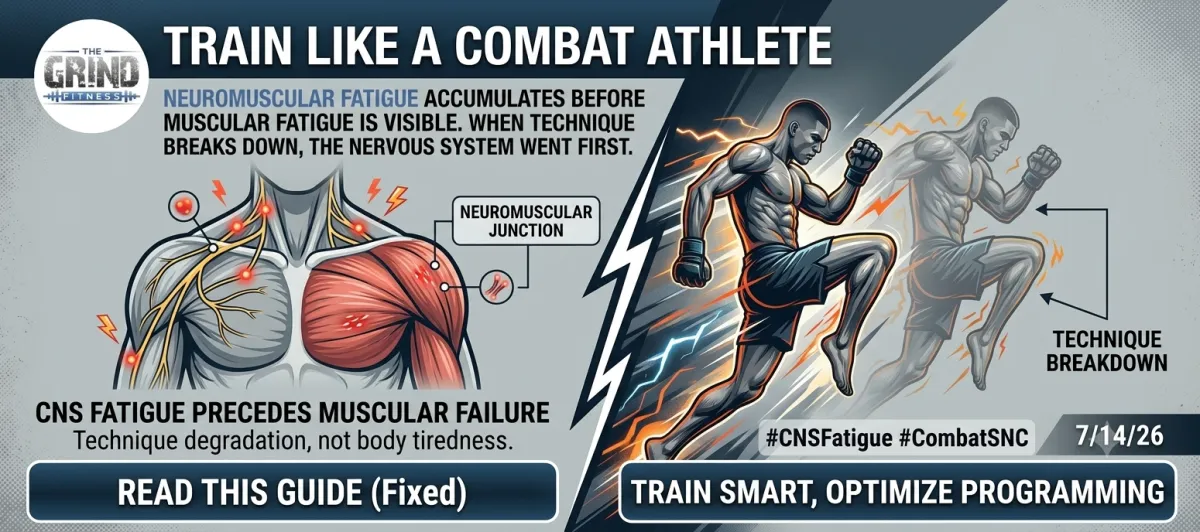
When Your Technique Breaks Down Before Your Body Feels Tired, Your Nervous System Went First
When Your Technique Breaks Down Before Your Body Feels Tired, Your Nervous System Went First
By Jairo Morales | Train Like a Combat Athlete
You have seen it happen. A fighter looks sharp in round one. His technique is clean, his timing is on, his movement makes sense. Then somewhere in the middle rounds, things start to fall apart. His punches lose their structure. His takedown entries get sloppy. His defensive positioning stops being instinctive and starts being reactive. And when you ask him about it afterward, he tells you he did not even feel that tired.
He is telling the truth. His muscles were not the first thing to go. His nervous system was.
This is one of the most misunderstood performance failures in combat sports training. When a fighter's technique breaks down before his body feels physically exhausted, the default explanation is mental. Coaches call it lack of focus. Athletes blame themselves for losing concentration. The real explanation is physiological, and it has nothing to do with toughness or mental weakness.
Neuromuscular fatigue accumulates before muscular fatigue becomes visible. And when nobody is programming for that, the fight exposes it every time.
Two Types of Fatigue, Two Different Timelines
To understand why technique breaks down before the body gives out, you need to understand that fatigue is not a single event. It operates through two distinct pathways that run on different timelines.
The first is peripheral fatigue. This is the fatigue most athletes recognize: the burning in the muscles, the heaviness in the limbs, the accumulation of metabolic byproduct in the working tissue. Peripheral fatigue is local. It happens in the muscle itself, at the level of the contractile fibers, and it is the type of fatigue that produces the physical sensations athletes associate with being tired.
The second is central fatigue. This originates in the central nervous system, specifically in the brain and spinal cord. <cite index="14-1">Central fatigue reduces the neural drive sent to motor units, leading to fewer motor neuron signals firing and changes in neurotransmitter levels that lower voluntary muscle activation.</cite> The muscle has not reached its limit. The signal telling the muscle to contract has already been dialed down.
<cite index="16-1">Research on neuromuscular fatigue in team and combat sport athletes shows that peripheral fatigue develops earlier at the neuromuscular junction and at the muscular level, and then central fatigue follows as peripheral fatigue increases, potentially acting as a protective mechanism to safeguard against further damage or injury.</cite> The body's own protection system is reducing output before the athlete consciously feels tired.
This is why technique breaks down first. Precise motor patterns require high-quality neural drive to execute consistently. When the nervous system starts downregulating output, the first thing that suffers is not gross force production. It is the fine motor coordination that holds technique together under pressure.
What This Looks Like in a Real Fight
The practical manifestation of central fatigue in a combat sports context is specific and recognizable once you know what you are looking at.
A boxer whose combination timing falls apart in round three even though his punch output has not dropped significantly. A wrestler whose level change starts telegraphing in the second period even though his legs still feel strong. A BJJ competitor whose guard passing sequences stop linking together fluidly even though he has not reached anaerobic threshold.
In each case, the technical quality is degrading while the physical capacity still appears intact. The athlete is not gassed. He is neurally fatigued. And because nobody told him these are different things, he interprets it as a mental failure rather than a physiological one.
<cite index="11-1">Research on neuromuscular fatigue in sprinters documents that technical breakdown appears before speed decreases, making technique monitoring one of the best early warning systems for central nervous system fatigue.</cite> The same principle applies directly to combat sports. When technique goes before the body does, the nervous system went first.
Why This Is a Programming Problem
Here is where most fight camps get this wrong. They treat technical breakdown under fatigue as a skills problem. They add more drilling. They run more sparring rounds. They push the athlete harder to build mental toughness.
None of that addresses the actual issue. If the nervous system is fatiguing faster than the training is preparing it for, no amount of drilling in a fresh state will solve what happens in a fatigued one. Technique trained only when the nervous system is recovered will always degrade when the nervous system is not.
The fix requires programming specifically for neural fatigue management, not just physical conditioning. This means two things.
First, training the body to maintain technical quality under accumulated neural load. This is done by building specific blocks where technical work is performed after neural output has already been taxed, not before. Drilling takedown entries or striking combinations after a heavy lifting session or a high-CNS conditioning block forces the nervous system to execute skilled movements from a depleted state. That is the training environment that produces real technical durability under competition conditions.
Second, programming adequate CNS recovery between high-intensity sessions. <cite index="15-1">Research on neuromuscular fatigue and recovery following maximal strength, jump, and sprint training shows that central nervous system recovery takes at least 48 hours following maximal efforts, with sprint training producing the highest neural fatigue of the common training modalities.</cite> A fighter who is sparring hard, sprinting, and lifting heavy in the same 48-hour window is accumulating neural debt faster than he is recovering from it. His technique in the third sparring round of the week is being judged against a nervous system that has never actually been given the space to recover.
This is the programming problem. Not toughness. Not focus. A training schedule that spends the nervous system faster than it can regenerate.
What to Do About It
The practical adjustments are structural, not motivational.
Sequence training sessions so that high-CNS output work, heavy lifting, sprinting, and hard sparring, are separated by at least 48 hours whenever possible. Monitor technique quality across the training week as a proxy for neural fatigue. When technique deteriorates earlier in sessions than it did the previous week, the nervous system is in deficit and recovery needs to take priority over volume.
Build specific blocks of technical work done under simulated neural fatigue: light drilling for precision immediately following conditioning work, with the explicit goal of maintaining technical quality when the nervous system is compromised. The athlete who can hold his technique in that state is the one who holds it in the final round of a fight.
The fighter who gets exposed technically in competition, not because his gas tank ran out but because his movement stopped being precise, was not undertrained in the gym. He was undertrained for the specific physiological state competition creates. Fix the program, not the mindset.
The Real Takeaway
Toughness is a real quality. But it does not override physiology. A nervous system in fatigue deficit will reduce technical output before the muscles ever signal distress, and no amount of mental effort changes that timeline.
When a fighter's technique breaks down before his body feels tired, his coach's job is not to push him harder. It is to look at the training schedule and find the week where the nervous system never got to recover.
That is where the problem started. And that is where the fix belongs.
Want a structured 180-day program built to develop elite-level strength, conditioning, and technical durability for combat sports? Book a free strategy call with Jairo today.
Sources
The Speed Project. Neuromuscular Fatigue in Sprinting: What Athletes Must Know. March 2026. https://www.thespeedproject.com/neuromuscular-fatigue/
Minett GM, Duffield R. Etiology and Recovery of Neuromuscular Fatigue following Competitive Soccer Match-Play. PMC. 2017. https://pmc.ncbi.nlm.nih.gov/articles/PMC5661001/
Institute of Human Anatomy. How Fatigue Affects Neuromuscular Control in Fitness. April 2026. https://www.instituteofhumananatomy.com/blog/how-fatigue-affects-neuromuscular-control-fitness
Claudino JG, et al. Neuromuscular Fatigue and Recovery after Heavy Resistance, Jump, and Sprint Training. PubMed. 2018. https://pubmed.ncbi.nlm.nih.gov/30067591/
Ingebrigtsen J, et al. Trends Assessing Neuromuscular Fatigue in Team Sports: A Narrative Review. PMC. 2022. https://www.ncbi.nlm.nih.gov/pmc/articles/PMC8950744/
Lopes-Silva JP, et al. Does Grappling Combat Sports Experience Influence Exercise Tolerance of Handgrip Muscles in the Severe-Intensity Domain? PMC. 2024. https://www.ncbi.nlm.nih.gov/pmc/articles/PMC10974517/
