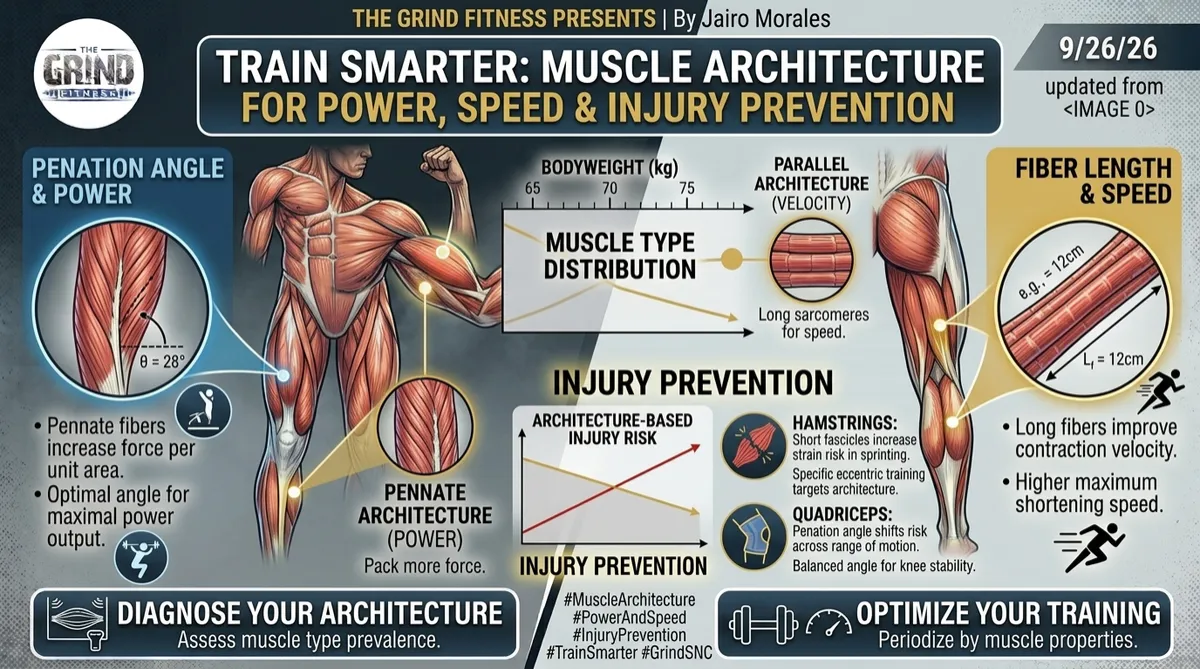
Train Smarter: Muscle Architecture for Power, Speed & Injury Prevention
When it comes to building high-performance athletes in combat sports, most programs focus on the what—squats, presses, sprints. But elite-level gains come from understanding the why. Muscle architecture—how muscle fibers are arranged, how long they are, and how they attach to tendons—determines how powerfully and efficiently your body moves. If you’re not training with this in mind, you’re leaving potential untapped and risking unnecessary injuries.
This blog breaks down the key architectural features of muscle tissue and how to train smarter to enhance output, reduce risk, and dominate the fight game.
What Is Muscle Architecture?
Muscle architecture refers to the structural layout of muscle fibers and connective tissue. The three primary elements that affect athletic performance are:
Pennation Angle
The angle at which muscle fibers insert into the tendon. A larger pennation angle allows for more fibers in a given area, which translates to greater force generation, but less speed.Fiber Length
Longer fibers can shorten more rapidly, improving contraction speed and range of motion. This is critical for striking, kicking, and scrambling.Tendon Elasticity (Series Elastic Component)
The spring-like behavior of tendons allows stored energy to be released explosively. Think of how a jab snaps or a leg recoils—tendon stiffness directly affects speed and economy.
Understanding how these variables interact lets you target adaptations that suit the demands of combat sports.
Pennation Angle: Force vs. Velocity
Muscles with greater pennation angles can pack more fibers into the same space. This is great for force production—think heavy squats and isometric holds. However, greater pennation reduces the speed of contraction. For fighters, you need a balance:
Train high-pennation muscles like the quads and glutes with compound lifts: trap bar deadlifts, Bulgarian split squats, and heavy sled pushes.
Avoid excessive hypertrophy that increases pennation without increasing usable force. Keep reps low-to-moderate and tempo controlled.
Combat athletes don’t just need to produce force—they need to express it fast. This is where fiber length comes in.
Fiber Length: Speed and Range of Motion
Longer muscle fibers can shorten more, which boosts movement velocity. This is critical for quick, reactive movements like:
Counterpunches
Defensive hip escapes
Shooting for takedowns
Explosive kicking
To develop longer, more efficient muscle fibers:
Incorporate eccentric training (slow lowering) to stimulate sarcomere addition in series.
Use loaded stretching techniques like RDLs with a pause at the bottom or deep split squats with a front-foot elevation.
Add isometric holds in stretched positions (e.g., isometric lunge holds) to increase muscle length under tension.
Tendon Elasticity: Stored Energy, Released Force
Your tendons act like springs. The stiffer they are, the more efficiently they store and release energy. Too compliant, and you lose energy. Too stiff, and you risk snapping under load. Combat athletes must walk the line between elastic efficiency and resilience.
To improve tendon properties:
Use low amplitude, high-frequency plyometrics (e.g., pogo jumps, mini-hops).
Train isometric holds under load (e.g., iso-split squat, iso calf raise).
Avoid chronic low-load/high-rep training, which can weaken tendon integrity.
Strong tendons improve reactivity, speed, and joint protection—three non-negotiables in combat sports.
Putting It All Together: Practical Programming
Muscle architecture adaptations don’t happen overnight. To build for power, speed, and durability:
Weekly Training Sample
DayFocusKey MethodsMondayMax StrengthTrap bar deadlifts, Bulgarian split squats, heavy sled pushesTuesdayLoaded StretchDeep RDLs, split squats with pause, isometric lunge holdsThursdayPlyometrics + SpeedBroad jumps, hill sprints, reaction ball drillsFridayMixed ForceClean pulls, rotational med ball throws, rebound jumps
Each training element addresses a different aspect of architecture:
Strength and hypertrophy increase pennation angle
Loaded stretching and eccentrics improve fiber length
Plyometrics and isometrics increase tendon efficiency
Injury Prevention Through Structure
Training for muscle architecture is also preventative.
Longer fibers reduce muscle strains by allowing more lengthening before failure.
Stronger, stiffer tendons protect joints by reducing unwanted motion and absorbing force.
Balanced force-velocity profiles prevent compensatory movement and overload.
Think of your body as a machine. The more mechanically optimized it is, the longer it lasts under pressure.
Why It Matters in Combat Sports
In the cage, ring, or mat, milliseconds matter. Strength alone isn’t enough. You need to be able to apply it with precision and speed. Here’s what training for muscle architecture can do:
Generate more force per strike or takedown
Reduce injury risk from explosive actions or awkward positions
Increase the usable range of motion in scrambles and transitions
Enhance reactive capabilities in standup, wrestling, and BJJ
Fighters who move efficiently and hit hard without breaking down are the ones who win consistently.
Train Smarter, Not Just Harder
Combat athletes don’t need more random volume or cookie-cutter bodybuilding routines. They need intelligent programming that respects how the body actually functions.
Muscle architecture gives you the blueprint.
Don’t just lift—build structure. Don’t just train—adapt for performance.
Want a structured 180-day program that addresses mobility, strength, power, and athletic performance in the correct sequence for combat sports? Book a free strategy call with Jairo today.
References
Lieber RL, Fridén J. Functional and clinical significance of skeletal muscle architecture. Muscle Nerve. 2000.
Kubo K, Kanehisa H, Fukunaga T. Effects of resistance and stretching training programs on the viscoelastic properties of human tendon structures. Eur J Appl Physiol. 2002.
Brughelli M, Cronin J. Influence of running velocity on vertical, leg and joint stiffness. Sports Med. 2008.
Wackerhage H, Schoenfeld BJ, et al. Stimuli and sensors that initiate skeletal muscle hypertrophy following resistance exercise. J Appl Physiol. 2019.
Blazevich AJ. Effects of physical training and detraining, immobilisation, growth and aging on human fascicle geometry. Sports Med. 2006.
