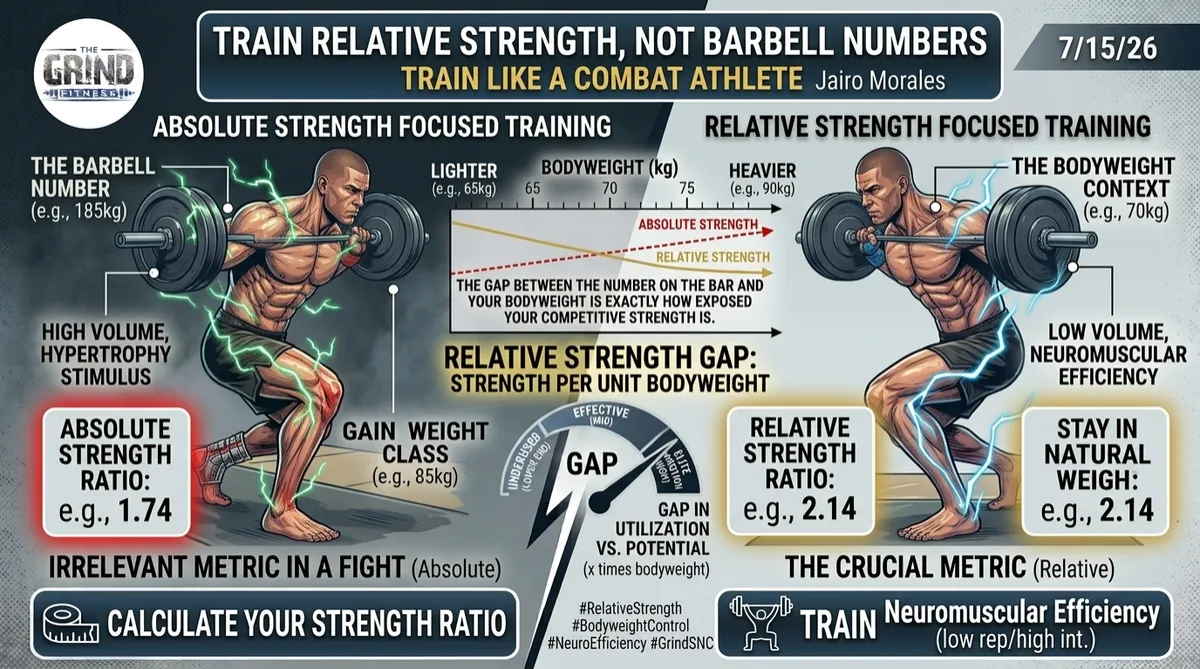
Train for the Weight Class. Not the Barbell Number.
By Jairo Morales | Train Like a Combat Athlete
There is a number most combat athletes chase in the gym. It sits on the barbell. It shows up in conversation after training. It gets compared across training partners and used as an informal measure of who is the strongest in the room.
That number is almost irrelevant to what actually happens in a fight.
The metric that determines who controls positions, who wins scrambles, and who physically imposes their game on an opponent is not absolute strength. It is relative strength: the amount of force a fighter can produce per unit of his own bodyweight. And most combat athletes have never once programmed specifically for it.
What Relative Strength Is and Why It Is the Right Metric
Absolute strength is the total force you can produce. It is what shows up as a number on a barbell. Relative strength divides that number by your bodyweight, which gives you a ratio that reflects how strong you actually are for your size.
Relative strength is the amount of force you can produce relative to your bodyweight. In weight class sports like BJJ, wrestling, and MMA, improving relative strength directly benefits performance because the competition environment is defined by athletes of similar bodyweight competing against each other.
The math is clear. A fighter who weighs 185 pounds and squats 315 has a relative strength ratio of 1.70 times bodyweight. A fighter who weighs 170 pounds and squats 285 has a ratio of 1.68 times bodyweight. They are essentially equal in relative strength despite a 30-pound difference in total squat output and a 15-pound difference in bodyweight.
Now flip the scenario. That 185-pound fighter steps onto the mat against a 185-pound opponent who squats 285 pounds. His opponent's relative strength ratio is 1.54. He is weaker relative to his own bodyweight than either fighter in the previous example, despite moving the same absolute load on the bar.
This is why the barbell number alone means nothing without context. In a weight class sport, the context is always your bodyweight. The fighter who is stronger relative to his own bodyweight has the physical advantage at every point of contact, regardless of what either athlete can lift in isolation.
What the Research Says About Relative Strength in Combat Sports
The evidence on this is direct.
Higher-level MMA athletes presented significantly higher relative back squat strength than lower-level athletes, at 1.8 times bodyweight compared to lower-level competitors, with higher-level athletes also tending to present higher relative bench press strength. The research concluded that maximal lower-limb dynamic strength expressed relative to bodyweight is crucial for differentiating performance levels in MMA competition.
The key phrase is expressed relative to bodyweight. The research did not find that elite MMA athletes simply lifted more weight. It found that they were stronger per pound of their own bodyweight. That ratio is what separated competitive levels, not the absolute number.
When accounting for bodyweight in BJJ athletes, differences in absolute bench press strength between athletes disappeared entirely, suggesting that relative expression of strength rather than absolute output is the more meaningful performance variable in grappling competition.
This tells you everything about how to train. The fighter who adds 20 pounds to his squat while gaining 15 pounds of bodyweight has not made a meaningful improvement in his competitive strength position. The fighter who adds 20 pounds to his squat while maintaining his weight class has made a direct improvement in the quality that determines who controls positions.
Why Most Combat Athletes Are Training the Wrong Variable
The default programming approach for most combat athletes is built around absolute strength. More weight on the bar. More reps. More volume. More sessions.
A common mistake combat athletes make is an over-reliance on mid-to-high rep ranges, which builds size and work capacity but does not specifically develop the strength-to-weight ratio that a weight class sport demands.
Moderate rep ranges with moderate loads are a conditioning tool. They build muscle endurance and contribute to hypertrophy. They are not the primary stimulus for relative strength development, which requires training the neuromuscular system to produce maximum force output from the muscle mass that is already there rather than adding more of it.
There is also the weight class problem. A fighter who adds significant muscle mass to chase a bigger barbell number may be pushing himself out of his natural weight class or forcing a more aggressive and performance-compromising cut to make weight. Both outcomes reduce his competitive advantage. A heavier fighter who has to cut harder arrives at competition more depleted. A fighter who has moved up a weight class is now competing against athletes who are naturally larger and may also be equally strong relative to their bodyweight.
The fighter who stays at his natural weight class and builds relative strength within it is the one who arrives at competition in the best physical position: not depleted from cutting, not outweighed, and stronger per pound than his opponent.
How to Train Specifically for Relative Strength
Relative strength development requires a specific training approach that prioritizes neuromuscular efficiency over hypertrophy. The goal is to get more force out of the muscle mass you have, not to build more of it.
The primary training tool is low-rep, high-intensity strength work in the 85 to 95 percent of one-rep maximum range. Sets of 1 to 5 repetitions at these intensities drive the neural adaptations that produce relative strength gains: improved motor unit recruitment, increased rate of force development, and better intermuscular coordination. These are the qualities that transfer to position control, takedown entries, and the ability to impose physical pressure on an opponent without adding bodyweight to do it.
Optimizing force production in the upper and lower body relative to bodyweight is important for elite and professional MMA athletes. The implication for programming is that strength training for combat sports should be benchmarked and progressed against the athlete's bodyweight rather than against absolute load increases alone.
Practically, this means tracking your strength ratios, not just your total lift numbers. A 185-pound fighter should know his squat-to-bodyweight ratio, his deadlift-to-bodyweight ratio, and his press-to-bodyweight ratio. When these ratios improve, his relative strength has improved. When the ratio stays flat because absolute strength and bodyweight increased proportionally, nothing meaningful changed for his weight class performance.
Session structure for relative strength prioritizes compound movements with maximal intent, adequate rest between sets (3 to 5 minutes for true strength adaptations), and conservative volume that does not compromise recovery from combat training. The goal is quality of neural output, not metabolic stress. This is not a conditioning session. It is a strength session, and those are different adaptations that require different approaches.
What This Looks Like as a Competitive Advantage
Two fighters of equal size step onto the mat. They are both 170 pounds. One has trained to add weight to his barbell and grown into his strength. The other has trained to produce more force from the same bodyweight he has always competed at.
The second fighter is stronger at every point of physical contact. His takedown entries generate more force per pound. His clinch pressure is harder to manage. His escapes and scrambles are more explosive relative to the load he is moving, which is always his own bodyweight. His positional control is more authoritative.
None of this shows up as a dramatic difference in the gym. But it shows up in every position that matters in a fight.
Train for the weight class, not the barbell number. The ratio between your strength and your bodyweight is the number that determines who controls positions when it counts.
Want a structured 180-day program that addresses mobility, strength, power, and athletic performance in the correct sequence for combat sports? Book a free strategy call with Jairo today.
Sources
PMC. Maximum Isometric and Dynamic Strength of Mixed Martial Arts Athletes According to Weight Class and Competitive Level. July 2022. https://pmc.ncbi.nlm.nih.gov/articles/PMC9323058/
Sweet Science of Fighting. BJJ Strength and Conditioning: The Complete Guide. January 2026. https://sweetscienceoffighting.com/strength-training-for-brazilian-jiu-jitsu-bjj/
PMC. Experience, Training Preferences, and Fighting Style Are Differentially Related to Measures of Body Composition, Strength, and Power in Male Brazilian Jiu Jitsu Athletes. January 2023. https://www.ncbi.nlm.nih.gov/pmc/articles/PMC9866903/
BJJ Strength Camp. Relative Strength for BJJ. March 2022. https://www.bjjstrengthcamp.org/blog/relative-strength-for-bjj
MDPI. Effects of Strength Training on Physical Fitness of Olympic Combat Sports Athletes: A Systematic Review. February 2023. https://www.mdpi.com/1660-4601/20/4/3516
ResearchGate. Special Issue: Strength and Conditioning for Combat Sports Athletes. March 2021. https://www.researchgate.net/publication/350431980
PMC. Applied Research on the Impact of a Neuromotor Development Program on the Lower Limb Strength of Junior Athletes in Greco-Roman Wrestling. 2025. https://www.ncbi.nlm.nih.gov/pmc/articles/PMC12736863/
