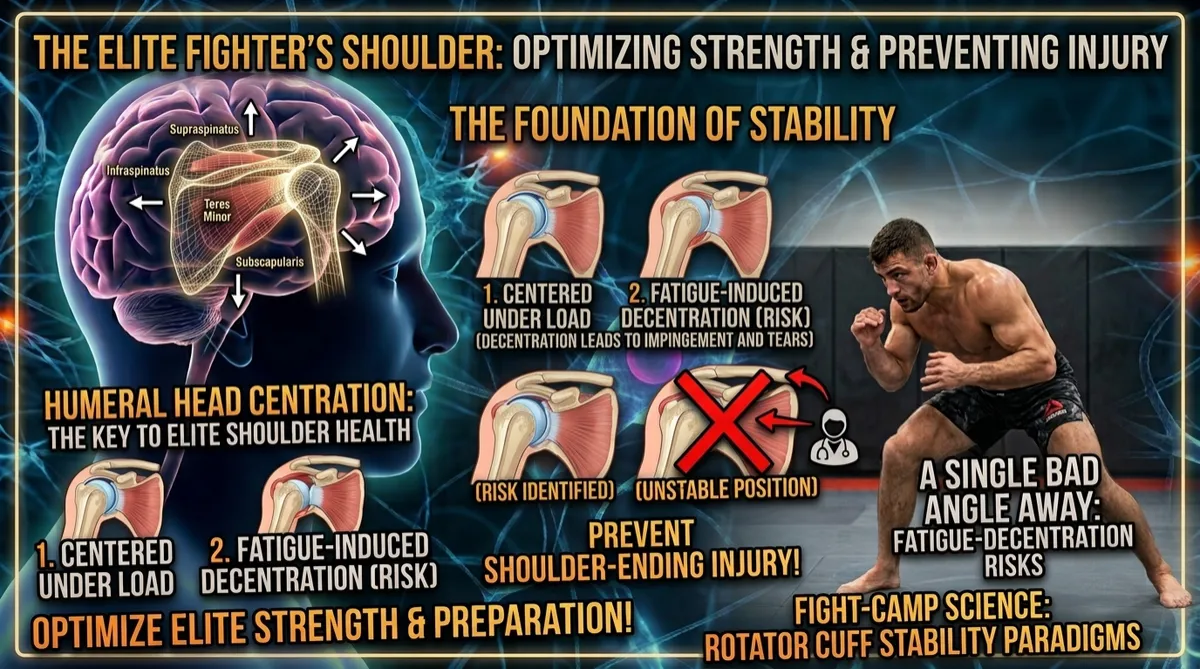
The Shoulder That Ends Fight Camp Early Was Not Injured in One Exchange. It Was Undertrained for Years.
By Jairo Morales | Train Like a Combat Athlete
The shoulder is the most mobile joint in the human body. That mobility is also what makes it the most vulnerable joint in combat sports. A ball sitting in a shallow cup, held in place by four small muscles operating in coordinated opposition, sustaining pressing loads, pulling loads, striking loads, and clinch pressure across the full duration of a training camp.
When the system that keeps that ball centered fails under fatigue, the result is not usually a dramatic acute injury. It is a progressive compromise that accumulates quietly over weeks until one bad angle in the clinch, one awkward landing, one compromised position under load produces the moment that ends the camp.
The system responsible for keeping the humeral head centered in the glenoid fossa under all of those loads is called a force couple. Most combat athletes have never once trained it deliberately. And that gap is why shoulder injuries end fight camps at the rate they do.
What a Force Couple Is and Why the Shoulder Depends on One
The glenohumeral joint, the ball and socket that forms the shoulder, is inherently unstable by design. The glenoid fossa, the socket, is extremely shallow. The humeral head, the ball, is only covered by approximately 25 to 30 percent of the glenoid surface in any given position. This architecture allows for the extraordinary range of motion that combat sports demand, but it means that dynamic stability has to be actively produced by the surrounding musculature at all times.
The rotator cuff creates a force couple around the glenohumeral joint with coordinated activation and inactivation of agonist and antagonist muscles, working synergistically to contain the otherwise intrinsically unstable glenohumeral joint and prevent proximal migration of the humerus.
A force couple is a system where two opposing forces act on a structure to produce rotation without translation. In the shoulder, the shoulder has two key force couples operating in two planes. In the coronal plane, the deltoid pulls the humeral head upward during abduction, creating an upward rotational force that is counteracted by the subscapularis, infraspinatus, and teres minor applying a stabilizing downward and inward counter force. In the transverse plane, the subscapularis pulls the humeral head anteriorly during internal rotation, creating a rotational force that is counteracted by the infraspinatus and teres minor to prevent the humeral head from translating out of the glenoid fossa.
When both couples are functioning correctly, the humeral head stays centered in the glenoid through the full range of every pressing, pulling, and striking movement. The joint compresses into the socket rather than sliding across it. Force transfers efficiently and the structures of the shoulder operate within their designed tolerances.
When one side of either couple is weak, fatigued, or uncoordinated, the balance breaks. The humeral head translates rather than rotates. Patients with rotator cuff tendinopathy have been noted to have excess anterior superior translation of the humeral head when doing active arm elevation by up to 3mm in the anterior direction and between 1.0mm and 1.5mm in the superior direction. Those numbers sound small. Under repeated high-force loading across a full training camp, they are the difference between a shoulder that holds and one that does not.
Why Fatigue Changes Everything
A fighter with adequate rotator cuff strength in a fresh state may still have a shoulder that fails under fatigue if his force couple training has never specifically addressed sustained output under load.
Balanced force couples in the transverse and coronal planes help to maintain normal glenohumeral mechanics. Unloaded or compromised conditions significantly increase superior and posterior humeral head translations and reduce contact force and area.The research uses structural compromise as the model, but the functional parallel for a combat athlete is a force couple that is present when fresh and absent when fatigued. The outcome is the same: the humeral head translates out of its centered position, contact mechanics change, and the structures being asked to tolerate load are now absorbing it from an angle they were not designed for.
A fighter whose rotator cuff cannot keep the humeral head centered under fatigue is not just at risk during obvious high-force moments like a takedown or a punch. He is at risk in every clinch exchange in the late rounds when the shoulder musculature has been under sustained load for twelve to sixteen minutes and the force couples are no longer producing the coordinated balance they were producing in round one.
One bad angle in that state is enough. The tissue was already compromised. The angle just revealed it.
What Most Fighters Are Training Instead
The default shoulder training approach in most combat sports programs is built around the prime movers. Bench press, overhead press, rows, pull-ups. These exercises develop the muscles that produce gross force output at the shoulder. They do not specifically train the force couples that determine whether the humeral head stays centered while that force is being produced.
The mechanism where shoulder stability is provided by the glenoid concavity and the compressive force generated by the rotator cuff muscles is known as concavity compression. Without adequate rotator cuff force couple balance, the deltoid's upward pull on the humeral head goes unchallenged and the head migrates superiorly, reducing the subacromial space and increasing impingement risk with every overhead and pressing movement.
A fighter with a strong bench press and weak posterior rotator cuff is building force production capacity on top of an unstable joint. Every heavy press, every striking combination, and every clinch exchange under that configuration is loading a shoulder that is not keeping the ball centered in the cup. Over the course of a fight camp, this is how shoulders fail without a single dramatic incident to point to.
How to Train the Force Couple Directly
Force couple training for the rotator cuff requires targeting the muscles of the posterior cuff specifically, because these are the structures most commonly undertrained relative to the anterior muscles developed through pressing and striking.
These findings support targeted strengthening of the posterior cuff to help maintain joint congruency, minimize abnormal glenohumeral contact mechanics and humeral head translation, and potentially delay the progression of shoulder pathology.
External rotation work is the foundational tool. Cable external rotation at neutral, side-lying dumbbell external rotation, and band external rotation performed with the elbow fixed at 90 degrees all target the infraspinatus and teres minor directly, the two muscles most responsible for the transverse plane force couple that resists anterior humeral head translation. These are not accessory exercises. They are the foundation of a shoulder that holds position under fatigue.
Prone Y, T, and W movements target the lower trapezius and serratus anterior alongside the posterior cuff, building the scapular stability that the force couple depends on to function correctly. The rotator cuff cannot center the humeral head if the glenoid itself is not positioned correctly, and scapular control determines where the glenoid sits during every overhead and pressing movement.
Isometric external rotation holds performed at 70 to 90 percent of maximum effort for 30 to 45 second durations specifically target the force couple's capacity to sustain its balancing function under prolonged load, which is exactly the demand that clinch exchanges and sustained grappling place on the shoulder in the late rounds of a session.
The programming principle that governs all of this is consistency over intensity. The rotator cuff muscles are relatively small and recover quickly. Two to three sessions per week of targeted force couple work, done consistently across the full preparation cycle and maintained at reduced volume during fight camp, builds the specific capacity that keeps the shoulder centered when everything else is breaking down from fatigue.
The Shoulder That Finishes Camp
Two fighters enter fight camp with equivalent strength, conditioning, and technical preparation. One has specifically trained his rotator cuff force couples across the twelve weeks prior to camp. The other has done the same bench press, the same rows, the same conditioning work, and never once specifically trained the system that keeps the humeral head centered under load.
By week six of camp, when the cumulative sparring load has been building for weeks and every session is starting from a state of residual fatigue, the difference is specific and direct. The first fighter's rotator cuff is still producing the force couple balance that keeps his humeral head centered through every clinch exchange. His shoulder is absorbing load from a mechanically sound position.
The second fighter's posterior cuff is the first thing to fatigue because it was never specifically prepared for sustained output under load. His humeral head is translating in the late rounds. Every awkward angle in the clinch is loading his shoulder from a compromised position. The injury that ends his camp has been building since week one. It will announce itself in week seven.
Train the force couple. The shoulder that finishes camp is the one that was specifically prepared to do so.
Want a structured 180-day program that addresses mobility, strength, power, and athletic performance in the correct sequence for combat sports? Book a free strategy call with Jairo today.
Sources
PubMed. Compensatory Load Sharing by Residual Rotator Cuff Subregions Preserves Glenohumeral Mechanics in Partial and Massive Tears. May 2025. https://pubmed.ncbi.nlm.nih.gov/41637491/
PMC. Biomechanical Simulations Informed by Multimodal Measurements Link Symptoms to Glenohumeral Joint Forces Across Healthy and Pathological Rotator Cuffs. July 2025. https://pmc.ncbi.nlm.nih.gov/articles/PMC13494848/
PMC. Rotator Cuff Injury: Pathogenesis, Biomechanics, and Repair. November 2024. https://pmc.ncbi.nlm.nih.gov/articles/PMC11580759/
PMC. The Biomechanics of the Rotator Cuff in Health and Disease. May 2021. https://pmc.ncbi.nlm.nih.gov/articles/PMC8111677/
ShoulderDoc. Rotator Cuff Rehab Manual Centering. https://shoulderdoc.co.uk/pages/rotator-cuff-rehab-manual-centering
ShoulderDoc. Rotator Cuff Mechanics and Force Couples. https://shoulderdoc.co.uk/pages/rotator-cuff-mechanics
BoxLife Magazine. Isometric Holds at 70 Percent Max Effort for 30 Seconds May Stimulate Tendon Collagen Growth. April 2026. https://boxlifemagazine.com/iso-holds-stimulate-collagen-growth/
