The Most Underused Tool in Combat Sports Preparation Is Also the Simplest
By Jairo Morales | Train Like a Combat Athlete
Walk into most combat sports gyms and you will find athletes doing complex conditioning protocols, intricate barbell programs, and elaborate mobility work. What you will almost never find is someone picking up a heavy implement and walking with it for distance.
Loaded carries are not new. They are not complicated. They do not require specialized equipment or advanced programming knowledge. And they are the most underused tool in combat sports preparation by a significant margin.
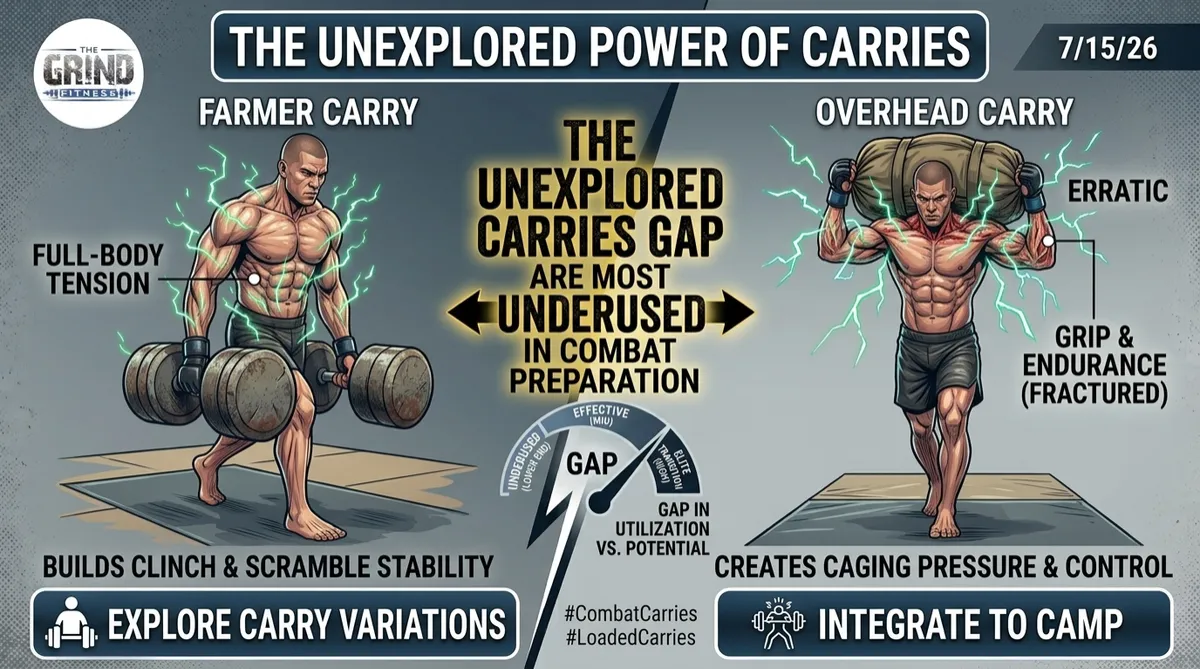
The farmer carry, the suitcase carry, and the overhead carry each develop a specific combination of qualities that almost no other training tool replicates: full-body tension under dynamic load, gait integrity while resisting a heavy external force, and grip endurance built in the exact context that combat sports demand it. These are not gym qualities. They are fight qualities. And the combat athlete who builds them deliberately shows up to every clinch, every scramble, and every cage pressure exchange with a physical foundation his opponent almost certainly did not build.
What Loaded Carries Actually Train
The farmer carry is deceptively simple. Pick up a heavy load in both hands and walk. But the simplicity of the movement conceals the depth of the training stimulus it produces.
Double-bell loading creates vertical compression through the spine and shoulders. The trapezius and shoulder stabilizers must prevent the shoulders from elevating while the core braces against the compressive forces. The walking component adds dynamic stability that static holds cannot provide. With each step, the center of mass shifts, requiring constant micro-adjustments to maintain balance and posture. This builds the reactive stability needed for real-world scenarios where the athlete must maintain control while moving.
Research by McGill found that during farmer carries, peak activation of the abdominal muscles and hip flexors occurred during the stance phase of gait, while the lats and low back muscles peaked during the swing phase.This means every step is producing a coordinated, full-body contraction across the anterior and posterior chain simultaneously. The body is not producing force in one direction. It is maintaining structural integrity across the entire system while moving under load.
Isometric grip training like loaded carries significantly improves maximal voluntary contraction and neuromuscular endurance, with the abdominal wall and obliques working to resist lateral sway and spinal extension, building anti-rotational core strength that protects the spine and improves performance in dynamic movements.
This combination of qualities, full-body tension, gait integrity, anti-rotation, and grip endurance built under movement, is the exact physical profile that combat sports demand in the positions that decide fights.
The Suitcase Carry: The Asymmetric Tool Most Fighters Never Use
The suitcase carry is the farmer carry's most underappreciated variation. One load. One side. And a completely different training stimulus that addresses a specific weakness almost every combat athlete carries without knowing it.
The suitcase carry builds single-hand grip ceiling beyond what bilateral work develops. The loaded shoulder faces a constant downward pull. Athletes with core asymmetry, which is almost everyone to some degree, can mask those imbalances during a bilateral carry in a way they cannot during a suitcase carry.
This matters enormously in combat sports because the positions that require grip and tension are almost never bilateral. A collar tie is one arm. A single-leg defense is one side of the body under load. A clinch exchange involves one arm extending, the other pulling, with the core working asymmetrically to maintain position against a resisting opponent. The suitcase carry trains exactly this: the ability to maintain structural integrity and produce force through the trunk when the load is unilateral and the body is fighting to compensate.
A one-handed carry loads the spine more than the same weight split between both hands, making the suitcase carry an anti-lateral-flexion tool that targets the obliques, quadratus lumborum, and gluteus medius in a way bilateral loading cannot replicate.
The fighter who has built anti-lateral-flexion strength through consistent suitcase carry work is the fighter who maintains his structure when an opponent is pulling one arm, pushing the other, and trying to break his posture in the clinch. That structural integrity is not something he is consciously producing in the moment. It is a quality he built in the gym that shows up automatically under pressure.
The Overhead Carry: Shoulder Stability Under the Hardest Demand
The overhead carry is the most technically demanding variation and the one that transfers most directly to the specific shoulder stability demands of combat sports.
The overhead carry demands shoulder stability, scapular control, and significantly more core engagement than bilateral or unilateral side carries. It is excellent for athletes who need to improve overhead strength and control, training thoracic extension and bracing under load simultaneously.
In combat sports, the shoulder is constantly being loaded in compromised positions. A wrestler extending his arms to control a tie-up, a BJJ athlete posting on his hand while scrambling, a striker throwing combinations with full shoulder extension, all of these movements require the shoulder to be stable under dynamic load, which is exactly what the overhead carry demands.
The overhead carry also trains the thoracic spine to maintain extension under compression, which is the postural quality that determines whether a fighter can maintain his structure in a deep clinch or whether his upper back rounds and his position collapses. A fighter with a strong, stable overhead position can absorb pressure from an opponent pushing into him without losing structural integrity. A fighter without it gets broken down over the course of a round simply through accumulated positional pressure.
How These Qualities Transfer to the Fight
The transfer from loaded carries to combat sports performance is direct and specific across three of the most decisive physical contexts in any fight.
Cage pressure and clinch control require sustained full-body tension against a resisting opponent. The fighter who has built the capacity to maintain total-body bracing under load through farmer carry work is the fighter who can apply and sustain cage pressure without his structure degrading over the course of a round. He is not stronger in the traditional sense. He is more structurally durable under the specific type of sustained force that cage pressure demands.
Clinch control requires the asymmetric tension and anti-lateral-flexion strength that the suitcase carry specifically develops. The fighter who can maintain his structure when one arm is being controlled and the other is working has a foundational advantage in every tie-up exchange that cannot be replicated by any bilateral strength exercise.
Scramble survival requires the combination of grip endurance, gait integrity, and reactive stability that loaded carries build across all three variations. A scramble is a chaotic, high-speed sequence of positions where the athlete who can maintain structural control while moving under load and fatigue survives. The farmer carry trains exactly that: maintaining structure, grip, and full-body tension across dynamic movement under load, for duration.
Carries develop armor for the body: powerful grip, solid trunk, endurance, and mental toughness. For athletes, carries are functional strength with conditioning. The key is not to overdo them to the point of interfering with recovery from main lifts or sport practice.
How to Program Them
Loaded carries belong at the end of a strength session or as a conditioning finisher, not as a primary lift. They are a complement to the main work, not a replacement for it.
Farmer carries: moderate to heavy load, 30 to 50 yards per set, 3 to 4 sets. The limiting factor should be postural integrity, not grip failure. When the shoulders start to elevate and the trunk starts to lean, the set is over.
Suitcase carries: moderate load, 20 to 30 yards per side, 3 sets each side. Keep the non-working arm completely relaxed at the side so the core does the work, not the arm.
Overhead carries: lighter load than farmer or suitcase, 20 to 30 yards per set, 2 to 3 sets. Prioritize shoulder position and thoracic extension over distance. A short set done correctly produces more adaptation than a long set with a collapsed overhead position.
Two sessions per week across a training block is appropriate for most combat athletes. Separate heavy carry sessions from heavy pulling sessions by at least 48 hours to allow grip and posterior chain recovery before the next high-demand session.
The Bottom Line
Loaded carries do not look impressive. They do not have a high skill ceiling that takes years to develop. They do not produce the kind of gym highlight reel that more complex movements do.
What they produce is a fighter who is structurally durable under sustained load, who can maintain grip and full-body tension across the duration of a scramble, who holds his position in the clinch when an opponent is trying to break it, and who applies cage pressure with a structural integrity that does not degrade as the round progresses.
Pick up something heavy and walk with it. Then do it again. The simplest tool in the gym is the one most combat athletes are leaving on the floor.
Want a structured 180-day program that builds elite-level strength, conditioning, and structural durability for combat sports? Book a free strategy call with Jairo today.
Sources
2110 Fitness. Carries: Farmer, Suitcase, Overhead. Core, Grip, and Heart in One. November 2025. https://www.2110fitness.com/post/carries-farmer-suitcase-overhead-core-grip-and-heart-in-one
KB EMOM. Farmers Carry: Grip Endurance and Total-Body Tension. January 2026. https://kbemom.com/exercises/farmers-carry
Swolverine. Mastering the Farmer's Carry: Unlock Strength and Stability. April 2025. https://swolverine.com/blogs/blog/mastering-the-farmer-s-carry-unlock-strength-and-stability-with-this-essential-exercise-4
Repz. Suitcase Carry vs Farmers Carry. June 2026. https://www.repz.app/blog/suitcase-vs-farmers
Combat Fitness. Farmers Carry: Muscles, Benefits, Form. August 2026. https://www.combatfitness.co/post/farmers-carry-farmers-walk-guide
Fitness Warrior Nation. Farmers Carry Benefits: Strength, Grip, and Real-World Use. July 2026. https://www.fitnesswarriornation.com/farmers-carry-benefits/
Gymshark. Farmer's Carry: How to Do It, Why It Works and Variations. June 2025. https://www.gymshark.com/blog/article/guide-to-the-farmers-carry
