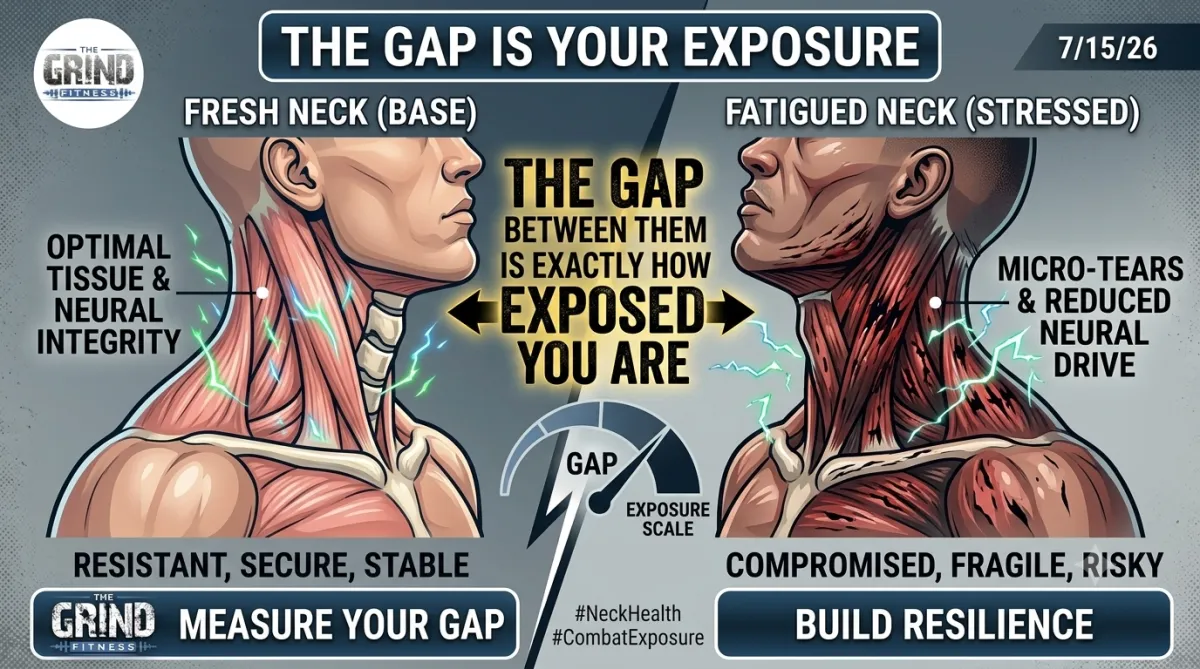
The Gap Between Your Fresh Neck and Your Fatigued Neck Is Exactly How Exposed You Are
The Gap Between Your Fresh Neck and Your Fatigued Neck Is Exactly How Exposed You Are
By Jairo Morales | Train Like a Combat Athlete
Every combat athlete knows he needs a strong neck. The connection between neck strength and knockout resistance has been discussed enough that most serious fighters at least acknowledge it. But almost none of them are testing the number that actually matters in a fight: not how strong the neck is when it is fresh, but how much of that strength is still available after four hard rounds of sparring.
That gap between the two numbers is not just a fitness metric. It is a direct measurement of how much protective capacity disappears at the exact moment a fight is most likely to produce head contact. The late rounds are when opponents are most desperate. They are when technique gets sloppy and shots come from unexpected angles. And they are when the neck that was strong in round one has been under continuous eccentric load for the previous twelve to sixteen minutes and is now operating at a significantly reduced capacity.
Testing neck flexion endurance fresh and then fatigued tells you precisely how wide that gap is. Most fighters have never run that test. They do not know how much their protective capacity drops, because they have never deliberately measured it under the conditions that actually matter.
Why the Neck Matters More Than Most Fighters Realize
The cervical musculature, the network of muscles that control and stabilize your head and neck, serves a function in combat sports that goes well beyond aesthetics or gross strength. It is your primary shock absorption system for head impacts. When a punch lands, the rate at which your head accelerates away from the point of contact determines how much force reaches the brain. The neck muscles, when strong and properly activated, act as a brake on that acceleration.
<cite index="24-1">Research on cervical predictors of concussion risk in MMA athletes shows that greater neck strength has been associated with lower concussion risk, with studies suggesting that each additional pound of neck strength may reduce concussion incidence by five percent. Anticipatory neck muscle activation appears to be particularly protective during sport-related impacts.</cite>
The word anticipatory is critical. A neck that can produce force on demand when it is expecting contact is protective. A neck that cannot produce that force because it is fatigued from the previous four rounds is not. The raw strength number means very little if the muscle cannot maintain output under the cumulative load of a full fight.
<cite index="21-1">Research on neck training in MMA athletes documents that muscular fatigue decreases an athlete's ability to engage anticipatory muscles and brace quickly and effectively for impact as time in competition continues.</cite> The window in which the neck can perform its protective function narrows with every round. And for most fighters, nobody has ever deliberately trained to keep that window open.
What Neck Flexion Endurance Actually Measures
Neck flexion endurance is specifically the capacity of the deep and superficial flexor muscles of the cervical spine to sustain force output over time and under load. This is the quality that keeps the chin down in a boxing context, holds the neck braced during a clinch, and maintains head position during a takedown defense.
Maximum strength in the neck, the amount of force it can produce in a single maximal contraction, is a related but different quality. A fighter can have adequate maximum neck strength and still have poor neck flexion endurance if his training has never specifically developed the capacity to sustain that strength under duration and fatigue.
This is the gap that the fresh-versus-fatigued test reveals. The difference between what the neck produces on rep one and what it produces after four rounds of hard contact and continuous eccentric loading is the actual performance variable that determines protective capacity when it is most needed. A fighter with a small gap between those two numbers has trained the right quality. A fighter with a large gap has trained maximum strength in isolation and ignored endurance entirely.
Why the Late Rounds Are the Most Dangerous Window
The timing of neck fatigue matters as much as the fact of it. Head contact in combat sports does not distribute evenly across rounds. Late rounds produce more head contact per minute of actual fighting than early rounds for several reasons: both athletes are more fatigued, defensive movement is slower, and the fighter who is losing is more likely to be taking risks that result in getting hit.
This means the rounds where a fighter most needs his cervical protective capacity to be functioning are precisely the rounds where it is most likely to have degraded. A fighter who enters round four with a significantly reduced neck flexion endurance is absorbing impacts with a protective system that is operating at a fraction of its fresh capacity, at the exact time when those impacts are most likely to occur.
<cite index="19-1">Research on recreational MMA athletes shows that cumulative exposure to combat sports is associated with alterations in cervical neuromuscular characteristics, with participants showing significant concussion-related symptom history despite no significant differences in measured cervical strength compared to non-contact athletes.</cite> This suggests that strength tested in isolation does not capture the functional protective capacity that competition demands. Endurance under cumulative load is the variable that actually determines protection.
How to Close the Gap
The test is simple. Measure neck flexion endurance fresh at the start of a session. Then run the same test at the end of four rounds of hard sparring. The difference between those two numbers is the gap. The training goal is to narrow it over time.
Closing that gap requires training neck flexion endurance specifically in a fatigued state, not just fresh. This means adding neck-specific endurance work at the end of hard sessions rather than only at the beginning. Isometric neck flexion holds, performed for extended durations after sparring rounds when the muscles are already fatigued, train the neck to sustain output from exactly the physiological position it will be in during late competition rounds.
<cite index="20-1">Research-backed neck training protocols for boxing and MMA emphasize performing neck training two to three times per week, with at least one session specifically targeting endurance and sustained isometric holds. During fight camp, the recommendation is to reduce volume but maintain frequency, keeping one abbreviated session per week focused on isometric and light resistance work to preserve the capacity built during the general preparation phase.</cite>
Progressive loading through weighted neck flexion with an emphasis on the eccentric phase, slow lowering over three to four seconds, builds the specific strength-endurance quality that holds up under fight-duration fatigue. Chin tucks and deep cervical flexor activation work build the foundational motor control that allows the neck to brace anticipatorily rather than reactively.
The neck that can sustain close to its fresh output through round four is not just a stronger neck. It is a neck that is still performing its primary protective function when the fight is most dangerous.
The Number Most Fighters Do Not Know
Most fighters can tell you their max neck flexion strength. Very few can tell you how much of it is left after four rounds of hard sparring.
That second number is the one that determines whether a fighter's protective capacity holds in the final rounds or quietly disappears at exactly the wrong time. Test both. Build the endurance that closes the gap between them. The fight does not know how strong you were at the start of round one. It only knows what you have left when it matters.
Want a structured 180-day program that builds elite-level strength, conditioning, and protection for combat sports from the ground up? Book a free strategy call with Jairo today.
Sources
Malvea A, et al. Identifying Cervical Predictors of Recreational Mixed Martial Arts Participation: A Case-Control Study. Sports. May 2025. https://doi.org/10.3390/sports13050155
Sportsmith. Neck Training to Improve Performance and Injury Outcomes. January 2026. https://www.sportsmith.co/articles/neck-training-to-improve-performance-and-injury-outcomes/
Iron Neck. Boxing Neck Training: Build Knockout Resistance and Injury Prevention. April 2026. https://www.iron-neck.com/blogs/articles/boxing-neck-training-knockout-resistance
VALD Performance. Neck Coupling Strength in MMA: Testing What Matters. October 2025. https://valdperformance.com/news/neck-coupling-strength-in-mma-testing-what-matters
Iron Neck UK. MMA Neck Conditioning Drills: The 2026 Elite Performance Guide. April 2026. https://iron-neck.co.uk/blogs/news/mma-neck-conditioning-drills-the-2026-elite-performance-guide
Tocayah. Neck Strength for MMA: Unstoppable Power. January 2025. https://tocayah.com/neck-strength-for-mma-build-unstoppable-power/
