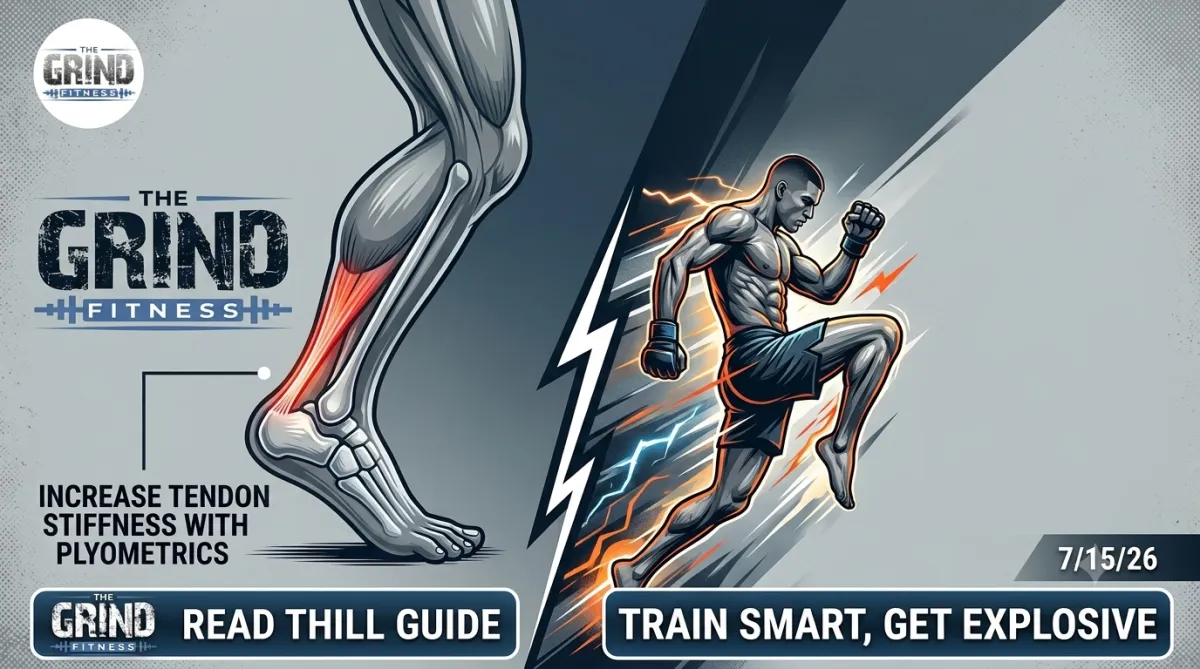
Stiffer Tendons Win More Exchanges. Here Is How to Build Them.
By Jairo Morales | Train Like a Combat Athlete
Every step you take in a fight costs energy. Every level change, every cut, every lateral movement requires your body to absorb force and then produce it again. Most fighters think about this in terms of muscle strength and conditioning. Almost none of them think about the structure that makes all of it more efficient: the Achilles tendon.
Your Achilles tendon is not just a connector between your calf and your heel. It is a spring. And like any spring, how stiff it is determines how much energy it stores and how much it returns. A stiffer Achilles tendon means more elastic energy stored during ground contact and more of that energy returned during push-off. Every step gets cheaper to produce. Every cut, every level change, every explosive footwork sequence costs your body less than it would with a compliant, undertrained tendon.
This is not a minor advantage. Over the course of a five-round fight, the cumulative energy savings from a well-adapted Achilles tendon can be the difference between a fighter who is still moving well in round five and a fighter whose footwork has gone flat.
What Tendon Stiffness Actually Means
Most athletes confuse tendon stiffness with rigidity. They are not the same thing. A stiff tendon in the performance context is one that deforms less under load and returns more of the energy it absorbs. Think of it as the difference between a cheap rubber band and a high-quality resistance band. The cheap one stretches easily and snaps back slowly. The high-quality one resists deformation and returns force immediately.
Your Achilles tendon behaves like a spring during the stretch-shortening cycle, which is the sequence of loading and unloading that happens every time your foot contacts the ground during movement. When the tendon is loaded during ground contact, it stores elastic energy. When you push off, that energy is returned to help propel your movement. A stiffer tendon stores and returns this energy faster and more efficiently than a loose one.
<cite index="9-1">Research on plyometric training adaptations shows that consistent plyometric exposure can increase Achilles tendon stiffness by approximately 24 percent and reduce energy dissipation by 35 percent, meaning the tendon returns significantly more elastic energy and loses less of it during the stretch-shortening cycle.</cite> Critically, <cite index="2-1">these changes occur without any significant increase in the cross-sectional area of the tendon itself, indicating that the adaptations are primarily qualitative changes in the tendinous tissue rather than structural growth.</cite> The tendon does not get bigger. It gets smarter.
Why This Matters More for Combat Athletes Than Almost Any Other Sport
Combat sports place a unique demand on the stretch-shortening cycle. A boxer cutting angles, a wrestler level-changing into a takedown, a BJJ competitor scrambling to his feet from guard, all of these movements require rapid loading and unloading of the lower limb. The Achilles tendon is involved in every single one.
<cite index="4-1">Elite athletes in explosive, reactive sports show sport-specific profiles of tendon stiffness and elastic energy return that reflect years of specific loading patterns.</cite> This means the adaptation is real, it is trainable, and it accumulates over time with consistent exposure to the right stimulus.
The combat athlete who has built Achilles tendon stiffness through deliberate training is moving more efficiently than his opponent at every moment of the fight. His footwork costs less. His level changes are sharper. His reactive movement is faster because less energy is being lost between ground contact and push-off. This is not a marginal gain. In a sport where the margin between landing a takedown and getting sprawled on is a fraction of a second, it matters enormously.
The Training Window: Why 8 to 12 Weeks Matters
Tendon adaptation does not happen quickly. Unlike neuromuscular adaptations, which can occur within the first few weeks of a new training stimulus, structural and qualitative changes in tendon tissue require consistent exposure over a longer window. The research on plyometric-driven Achilles adaptation consistently points to 8 to 12 weeks as the minimum timeline for meaningful changes in tendon mechanical properties.
This has a direct programming implication for combat athletes. Tendon stiffness training cannot be crammed into the final weeks of a fight camp. It needs to be built during the general preparation phase, well before competition-specific training begins, so that the tendon adaptations are in place by the time the athlete is doing the high-frequency, high-intensity work that fight camp demands.
A fighter who starts building Achilles stiffness 12 weeks out enters his fight camp with a more efficient spring already in place. A fighter who ignores this and tries to add plyometric volume during the final four weeks of camp is asking for overuse injury without the tissue having had time to adapt.
How to Build Achilles Tendon Stiffness
The most effective stimulus for Achilles tendon stiffness adaptation is consistent plyometric loading that emphasizes short ground contact times and maximal elastic energy return. This means training the stretch-shortening cycle, not just producing force.
Practical tools include pogos, ankle hops, and depth jumps performed with minimal ground contact time. The goal on every rep is to spend as little time on the ground as possible while producing maximum reactivity off the surface. This is the exact stimulus that drives the qualitative tissue changes the research identifies: not the amount of force produced, but the speed at which the tendon loads and unloads.
Two to three sessions per week, kept at low to moderate volume with high intent, is the appropriate dose during a general preparation block. Sessions should be done fresh, not at the end of conditioning work, because reactive quality degrades quickly under fatigue and fatigued plyometrics train the wrong quality.
Slow, heavy calf raises with a 3 to 5 second eccentric phase are a strong complement. Eccentric loading specifically targets the tendon's capacity to handle tensile stress and contributes to the tissue remodeling that underlies stiffness adaptation. Done consistently across an 8 to 12 week block alongside reactive plyometric work, this combination systematically upgrades the spring your fight game runs on.
The Bottom Line
Your conditioning program probably trains your lungs, your strength, and your anaerobic capacity. It almost certainly does not specifically train the structure that determines how efficiently all of that output gets translated into movement.
Achilles tendon stiffness is a trainable quality. It builds over 8 to 12 weeks of consistent plyometric and eccentric loading. And when it is built deliberately, every step, cut, and level change in a fight costs less than it did before.
That efficiency compounds across five rounds. By the time your opponent's footwork has gone flat and his level changes have slowed, yours has not. Build the spring. Everything attached to it performs better.
Want a structured 180-day program that addresses mobility, strength, power, and athletic performance in the correct sequence for combat sports? Book a free strategy call with Jairo today.
Sources
Fouré A, Nordez A, Cornu C. Plyometric Training Effects on Achilles Tendon Stiffness and Dissipative Properties. Journal of Applied Physiology. 2010. https://journals.physiology.org/doi/full/10.1152/japplphysiol.01150.2009
Wheeler Sports Tech. How Plyometric Training Helps Prevent Achilles Tendon Injuries. November 2025. https://www.wheelersportstech.com/2025/11/21/how-plyometric-training-helps-prevent-achilles-tendon-injuries/
Wiesinger HP, et al. Sport-Specific Capacity to Use Elastic Energy in the Patellar and Achilles Tendons of Elite Athletes. Frontiers in Physiology. 2017. https://pmc.ncbi.nlm.nih.gov/articles/PMC5346584/
Plos One. Substantial Achilles Adaptation Following Strength Training Has No Impact on Tendon Function During Walking. July 2021. https://journals.plos.org/plosone/article?id=10.1371/journal.pone.0255221
Fouré A, Nordez A, Guével A, Cornu C. Effects of Plyometric Training on Passive Stiffness of Gastrocnemii Muscles and Achilles Tendon. ResearchGate. December 2011. https://www.researchgate.net/publication/51843637
Iron Neck. Boxing Neck Training: Build Knockout Resistance. April 2026. https://www.iron-neck.com/blogs/articles/boxing-neck-training-knockout-resistance
Sportsmith. Neck Training to Improve Performance and Injury Outcomes. January 2026. https://www.sportsmith.co/articles/neck-training-to-improve-performance-and-injury-outcomes/
