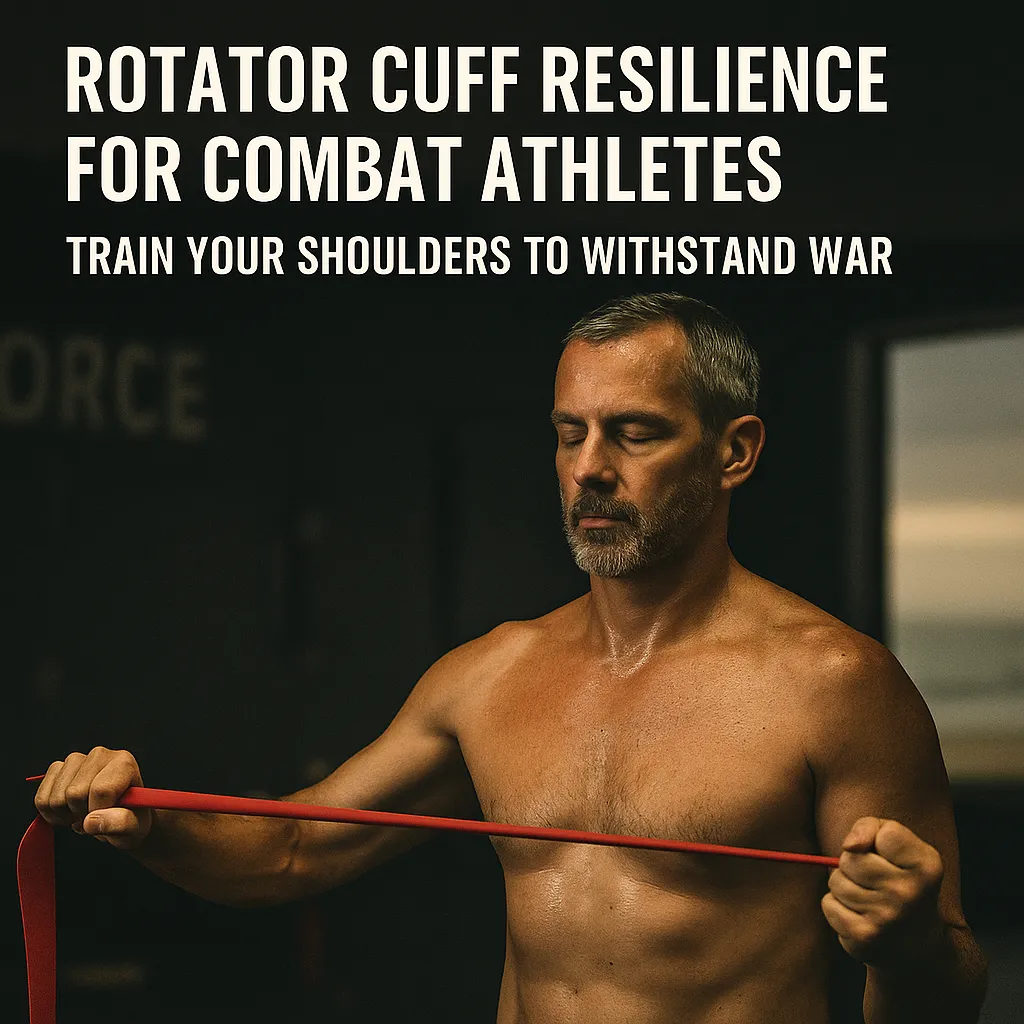
Rotator Cuff Resilience: Building Shoulders That Can Withstand Combat
In combat sports, shoulder injuries are among the most common setbacks that sideline fighters. From grappling exchanges to explosive punches, your shoulders take a beating. And the most vulnerable component of that complex joint? The rotator cuff.
If you’ve ever felt a dull ache after sparring, struggled with shoulder instability during overhead lifts, or heard a teammate talk about torn labrums and rotator cuff tears—you already know how serious this is. The good news is: these injuries are largely preventable.
What Is the Rotator Cuff?
The rotator cuff is a group of four muscles and their tendons that stabilize the shoulder joint:
Supraspinatus
Infraspinatus
Teres Minor
Subscapularis
These muscles work together to keep your humeral head (upper arm bone) centered in the shoulder socket during movement. In combat sports, they help stabilize the joint during strikes, frames, underhooks, and defensive postures—under heavy load and velocity.
Why Fighters Get Rotator Cuff Injuries
There are two primary causes of rotator cuff injuries in combat athletes:
Repetitive Microtrauma – Striking, posting, framing, and pulling over time create excessive stress without proper recovery or support.
Mobility/Strength Imbalances – Fighters often have overdeveloped anterior chain (pecs, delts) and underdeveloped posterior rotator cuff or scapular muscles, leading to instability and poor centration.
If your shoulder isn’t stable or strong in all planes of movement, the smaller stabilizing muscles take on more load than they should. Eventually, something gives.
High-Risk Movements for Fighters
Posting your arm during takedown defense
Overhead punches without proper scapular mechanics
Defending kimuras or armbars under torque
Repeated internal rotation from overuse of hooks or tight guard work
The Key to Shoulder Longevity: Train for Resilience, Not Just Strength
Building a durable rotator cuff requires high-volume, low-load movements that develop endurance, proprioception, and control—not just brute force.
Here are the core strategies:
1. High-Volume External Rotation Work
The external rotators (infraspinatus, teres minor) are critical for shoulder stability, especially in the retracted or defensive posture.
Go-to Exercises:
Banded external rotations (elbow at 90°)
Side-lying dumbbell ERs
Cable ERs with progressive tension
Prescription:
2–4 sets of 15–20 reps, 2–3x/week. Prioritize form and control over load.
2. Scapular Retraction & Control
The scapula (shoulder blade) serves as the foundation for arm movement. Weak or immobile scapulae = sloppy shoulders.
Drills to Include:
Prone I-Y-T raises
Wall slides with overhead reach
Banded scapular retraction rows
Scap push-ups
Train these movements with slow tempo and extended holds to develop scapular awareness and stability.
3. Overhead Isometrics & End-Range Stability
Combat athletes must control their arms in unpredictable positions—often overhead and under resistance.
Why Isometrics Work:
They build joint-specific endurance and reinforce control at vulnerable end ranges.
They increase time under tension without aggravating tendons.
Best Options:
Overhead plate holds (30–60 sec)
Bottoms-up kettlebell carries
Wall press isometrics (arm at 120° elevation)
4. Train Shoulder Rotation & Elevation Together
Rotator cuff injuries often happen because fighters train isolated motion but compete in complex, integrated movements.
Pair external rotation with scapular elevation:
Cuban presses (ER to overhead)
Banded face pulls to overhead reach
Tall-kneeling ER press-outs
These movements mimic the demands of real fight positions—especially when resisting submissions or posting up during a scramble.
Program Structure for Shoulder Resilience
Here’s how to plug this into your weekly schedule:
Phase 1 – Activation / Prehab (Warm-up)
5–7 minutes of:
Banded ERs
Scap retractions
Wall slides
Phase 2 – Integration (During S&C or Skill Training)
Add 2–3 sets of:
Bottoms-up carries
Scapular control drills between sets of compound lifts or drills
Phase 3 – Endurance / Durability (Finisher or Extra Work)
1–2x/week:
High-rep sets of ER + IYT raises
Isometric holds
Red Flags to Watch For
Clicking, popping, or grinding in the shoulder
Pain during overhead movements
Weakness in external rotation
Difficulty keeping shoulders “packed” during lifts
If you’re experiencing these, reduce high-load work and focus on motor control, isometrics, and recovery.
Rotator Cuff Recovery for Injured Fighters
Already dealing with shoulder pain? Here’s a recovery checklist:
Prioritize isometrics over dynamic movement initially
Temporarily avoid heavy horizontal pressing
Focus on blood flow and slow eccentrics
Gradually reintroduce load with low ROM exercises
Work with a PT or S&C coach to restore centration, then rebuild strength symmetrically.
Stop Playing Defense with Your Shoulders
If you’re not actively training your rotator cuff, you’re waiting for it to fail.
You don’t need 60 minutes of shoulder work every day—but 10–15 minutes of focused effort 3x/week can add years to your career and keep you pain-free during training.
Strong shoulders throw harder punches. Stable shoulders absorb takedowns. Resilient shoulders roll better and recover faster.
Don’t wait until you’re sidelined to take them seriously.
References
Escamilla, R. F., et al. (2009). Shoulder muscle activity during strength training exercises. Journal of Orthopaedic & Sports Physical Therapy, 39(2), 55–70.
Ellenbecker, T. S., & Cools, A. (2010). Rehabilitation of shoulder impingement syndrome and rotator cuff injuries: An evidence-based review. British Journal of Sports Medicine, 44(5), 319–327.
Reinold, M. M., et al. (2004). Electromyographic analysis of the rotator cuff and deltoid musculature during common shoulder external rotation exercises. Journal of Orthopaedic & Sports Physical Therapy, 34(7), 385–394.
