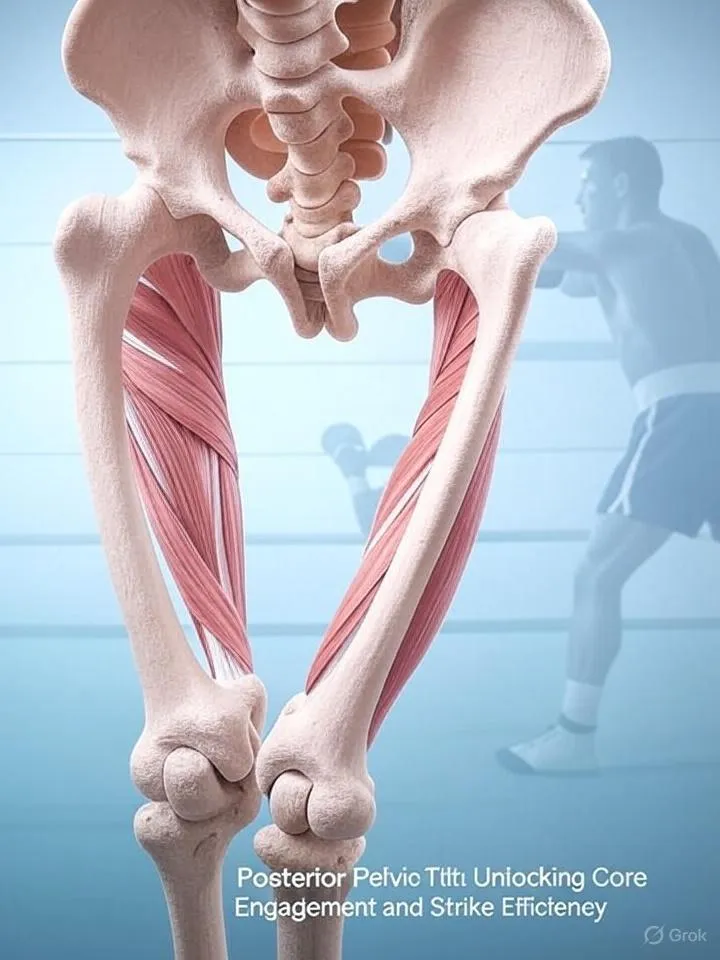
Posterior Pelvic Tilt: Unlocking Core Engagement and Strike Efficiency
In combat sports, every strike, sprawl, and scramble depends on how efficiently you connect your core and hips. The pelvis acts as the central link between the upper and lower body. Yet, one of the most undertrained aspects of this link is the posterior pelvic tilt (PPT).
Mastering PPT doesn’t just improve glute recruitment and core engagement. It enhances strike mechanics, reduces spinal stress, and builds resilience for long-term performance.
What Is Posterior Pelvic Tilt?
The pelvis has three main positions:
Anterior tilt: Pelvis tips forward, increasing lower-back arch. Often caused by tight hip flexors or dominant quads.
Neutral: Balanced alignment between spine and pelvis.
Posterior tilt: Pelvis tucks under, flattening the lower back while activating the glutes and lower abs.
For fighters, learning to control and transition between these positions—especially into PPT—creates a more stable and explosive base for movement.
Why Posterior Pelvic Tilt Matters for Fighters
1. Core Engagement
Posterior tilt activates the lower abs and deep core muscles, improving intra-abdominal pressure. This stability reduces energy leaks and keeps force output sharp throughout exchanges.
2. Glute Recruitment
The glutes fire more effectively when the pelvis is tucked under. Strong glutes drive hip extension—the foundation of knockout punches, sprawls, and takedowns.
3. Improved Strike Mechanics
Neutral and posterior pelvic positions align the spine and hips, allowing cleaner rotation. This reduces wasted energy and increases the whip-like efficiency of strikes.
4. Reduced Spinal Load
Fighters with chronic anterior tilt often overload the lumbar spine. Mastering PPT relieves this stress by redistributing force to stronger muscles, lowering risk of low back pain and injury.
Signs You’re Missing Posterior Pelvic Control
Overarched lower back during striking or grappling
Weak glute activation during hip-dominant movements
Core fatigue under pressure or in later rounds
Recurring hip tightness or lower-back discomfort
These red flags indicate a lack of pelvic control that’s costing performance and longevity.
How to Train Posterior Pelvic Tilt
Foundational Drills
Dead Bugs: Build awareness of neutral vs. posterior tilt while activating the core.
Glute Bridges: Teach glute firing with pelvic tuck under load.
Posterior Tilt Holds: Simple but effective for motor control.
Anti-Extension Core Work
Front Planks with Posterior Tilt
Stability Ball Rollouts
Ab Wheel Variations
Integrated Stability and Power
Pallof Press for anti-rotation stability
Split Squats with Tilt Control
Loaded Carries with neutral/pelvic tuck focus
Application to Combat Sports
Striking: Better alignment and glute drive equal cleaner hip snap, reduced back strain, and more efficient power transfer.
Grappling/Clinch: Stronger pelvic positioning creates harder-to-break posture and more effective control.
Sprawls/Defense: Stable hips improve resilience under pressure, reducing fatigue and injury risk.
You can’t out-technique a weak foundation. Posterior pelvic tilt is more than just a rehab cue. it’s a performance multiplier. By mastering pelvic control, you’ll strike harder, defend stronger, and protect your spine in the process.
Train it, own it, and carry it into every fight.
References
Contreras, B., & Schoenfeld, B. (2011). To crunch or not to crunch: An evidence-based examination of spinal flexion exercises, their potential risks, and their applicability to program design. Strength and Conditioning Journal, 33(4), 8–18.
McGill, S. (2010). Ultimate Back Fitness and Performance. Backfitpro Inc.
Sahrmann, S. (2002). Diagnosis and Treatment of Movement Impairment Syndromes. Mosby.
Kendall, F. P., McCreary, E. K., Provance, P. G., Rodgers, M. M., & Romani, W. A. (2005). Muscles: Testing and Function with Posture and Pain. Lippincott Williams & Wilkins.
Cholewicki, J., & Van Vliet, J. J. (2002). Relative contribution of trunk muscles to the stability of the lumbar spine during isometric exertions. Clinical Biomechanics, 17(2), 99–105.
