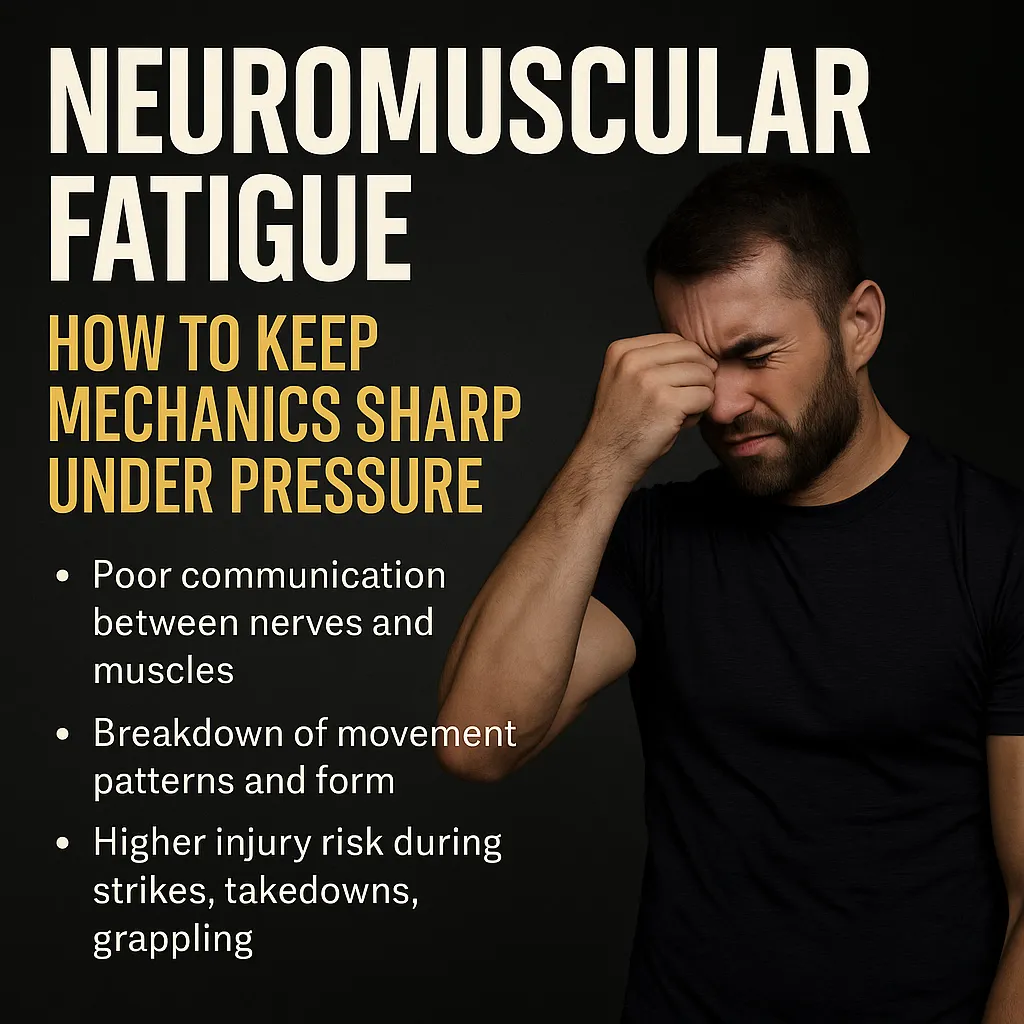
Neuromuscular Fatigue and Joint Mechanics: Protecting Performance in Combat Sports
Every fighter knows fatigue is inevitable. But what many underestimate is how quickly neuromuscular fatigue changes movement quality. Within minutes of high-intensity training, your body begins to lose its ability to coordinate joints effectively. Strikes become sloppy, sprawls lose stability, and takedowns risk injury. Combat sports demand peak mechanics under fatigue, which makes neuromuscular endurance and control just as important as strength and conditioning.
This blog unpacks how neuromuscular fatigue alters joint mechanics, why it matters for fighters, and the strategies you can use to stay sharp even when exhaustion sets in.
What is Neuromuscular Fatigue?
Neuromuscular fatigue isn’t just muscle tiredness. It’s a breakdown in the nervous system’s ability to communicate with the muscles. When the central nervous system (CNS) and peripheral systems are under stress, the following occur:
Reduced motor unit recruitment (fewer muscle fibers firing)
Slower firing rates
Delayed reflex responses
Altered proprioception and coordination
For fighters, this means your brain is sending weaker or slower signals to your muscles, and your mechanics start to shift even though you may not feel “tired” yet.
How Fatigue Alters Joint Mechanics
When neuromuscular fatigue kicks in, small leaks in form quickly become major inefficiencies. For example:
Knee valgus in sprawls and shots – The hips and glutes stop stabilizing properly, allowing the knees to cave in.
Shoulder elevation in striking – Fatigued scapular stabilizers force your upper traps to overwork, raising shoulders and wasting energy.
Lumbar extension during clinch work – Core stabilizers lose stiffness, and the lower back arches excessively, stressing the spine.
Slower deceleration in kicks – Fatigue reduces eccentric control, putting stress on knees and hips.
This doesn’t just waste energy; it reinforces poor motor patterns. Over time, fighters who consistently train through sloppy fatigue build mechanics that break down faster in competition.
Why It Matters for Fighters
Efficiency Loss – Poor mechanics waste energy, accelerating fatigue even more.
Injury Risk – Altered joint mechanics increase strain on ligaments and tendons, especially under high load.
Skill Transfer Breakdown – Training tired with poor form creates bad habits that transfer into live sparring and fights.
Reduced Power and Precision – When the kinetic chain is compromised, strikes lose snap, and takedowns lack control.
In short: neuromuscular fatigue doesn’t just make you tired, it makes you less skilled in real time.
Early Signs of Neuromuscular Fatigue
The body gives subtle warnings before mechanics completely break down:
Loss of posture in stance
Increased wobble or instability in single-leg positions
Grip strength drop-off (CNS fatigue indicator)
Delay between reaction and execution
More “noise” in movement (extra steps, swings, or twitches)
These signs should cue fighters to reduce volume, adjust intensity, or shift into technical drilling instead of forcing conditioning through sloppy reps.
Strategies to Manage Fatigue and Mechanics
1. Train Quality Over Quantity
Every conditioning drill should have technical integrity. If mechanics break down, stop the drill or adjust rest periods. Conditioning isn’t just about pushing limits—it’s about sustaining skill under stress.
2. Monitor Movement During Conditioning
Use video feedback or a coach’s eye to ensure mechanics hold under fatigue. For example:
Are knees tracking properly in sprawls?
Is posture maintained in takedown entries?
Is striking form crisp at the end of rounds?
3. Fatigue-Resistant Strength Training
Exercises that build endurance in stabilizers protect joint mechanics:
Isometric holds (split squat isometrics, plank variations)
High-rep scapular stability drills
Core stiffness endurance work (stir-the-pot, Pallof press variations)
4. Energy System Development
Conditioning isn’t just about going hard; it’s about matching fight demands. Use interval work that mimics combat rounds to prepare the nervous system for fatigue patterns. Example:
3 minutes of explosive work (to mimic a fight round)
1-minute technical recovery drill (shadowboxing with strict form)
5. Drill Technique Under Fatigue—But Controlled
There’s a fine line between reinforcing bad habits and building resilience. Fighters should occasionally practice technique while tired, but under strict supervision, ensuring mechanics remain sharp.
Example Training Applications
Striking Conditioning Drill:
30s heavy bag power combinations → 15s strict technical jab-cross → repeat x 5 rounds.
Forces clean mechanics under fatigue.Grappling Conditioning Drill:
3 sprawls + 1 clean takedown entry → 10s rest → repeat for 3 minutes.
Maintains shot integrity even when tired.Core Fatigue Drill:
Farmer’s carry for 40s → anti-extension plank for 20s.
Trains lumbopelvic control under CNS fatigue.
Recovery and Fatigue Management
Combat athletes often overlook recovery’s role in neuromuscular endurance. Without proper restoration, fatigue accumulates:
Sleep: Non-negotiable for CNS recovery.
Breathwork: Slow nasal exhalations reset the nervous system.
Nutrition: Adequate carbohydrates and electrolytes maintain nerve-muscle communication.
Deload Weeks: Reduce CNS stress to restore movement quality.
Neuromuscular fatigue is one of the most overlooked performance limiters in combat sports. It doesn’t just make you tired, it rewires your mechanics in ways that waste energy, reduce power, and increase injury risk. By training with movement quality as the standard, fighters can build fatigue resistance that keeps their skills sharp from the first bell to the last exchange.
In combat, fatigue is the enemy but smart training keeps your mechanics intact when it matters most.
References
Enoka, R. M., & Duchateau, J. (2016). Translating Fatigue to Human Performance. Medicine & Science in Sports & Exercise, 48(11), 2228–2238.
Gandevia, S. C. (2001). Spinal and supraspinal factors in human muscle fatigue. Physiological Reviews, 81(4), 1725–1789.
Noakes, T. D. (2012). Fatigue is a brain-derived emotion that regulates the exercise behavior to ensure the protection of whole body homeostasis. Frontiers in Physiology, 3, 82.
Paavolainen, L., Häkkinen, K., Hämäläinen, I., Nummela, A., & Rusko, H. (1999). Explosive-strength training improves 5-km running time by improving running economy and muscle power. Journal of Applied Physiology, 86(5), 1527–1533.
Behm, D. G., & Chaouachi, A. (2011). A review of the acute effects of static and dynamic stretching on performance. European Journal of Applied Physiology, 111(11), 2633–2651.
