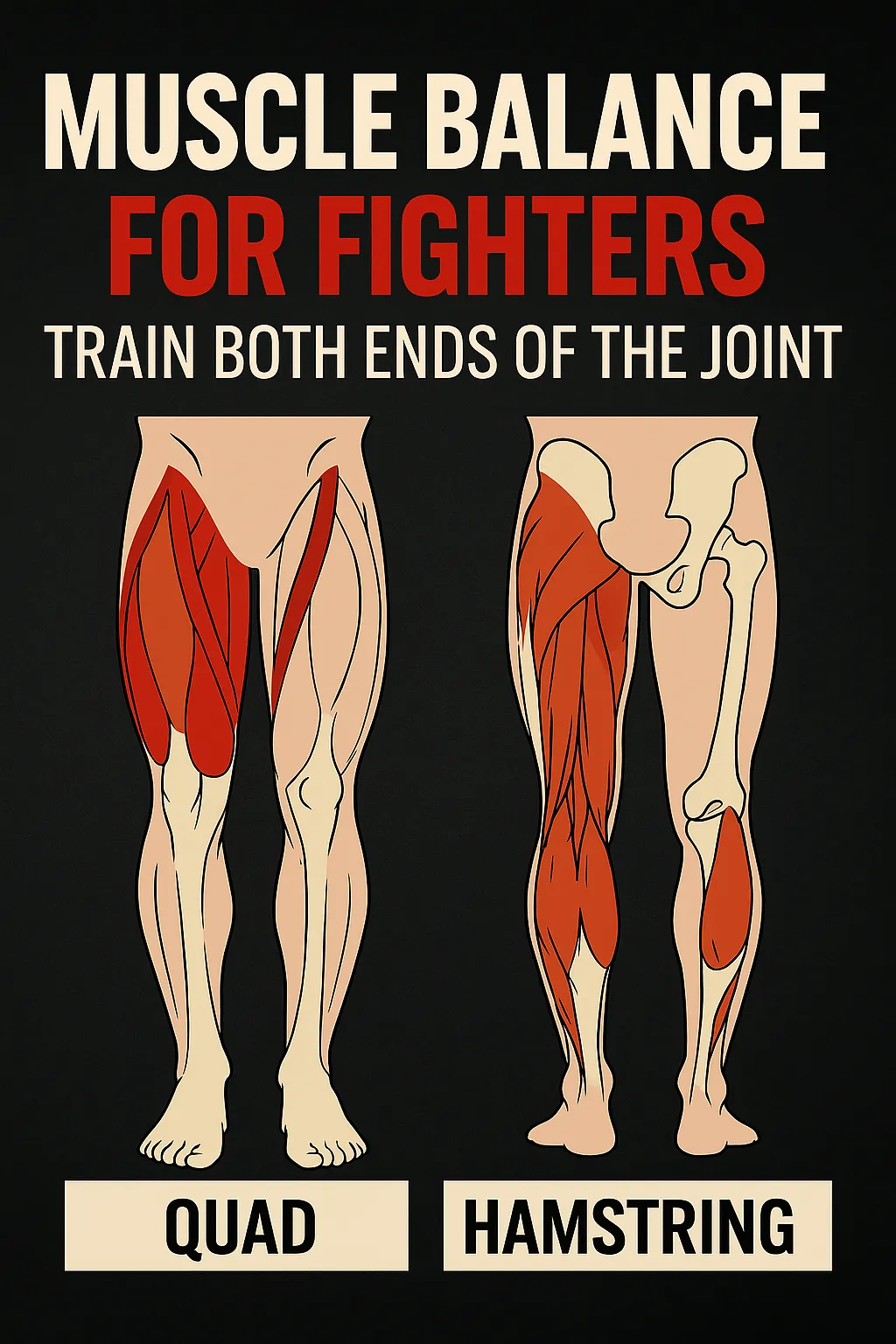
Muscle Balance in Combat Sports: Train Both Ends of the Joint
In combat sports, efficiency is everything. Every movement, whether it’s throwing a punch, shooting for a takedown, or defending a scramble, depends on precise coordination across opposing muscle groups. When one side of the joint is overdeveloped and the other side lags behind, energy leaks, performance suffers, and injury risk skyrockets.
Why Agonist–Antagonist Balance Matters
Muscles operate in pairs. The agonist generates movement while the antagonist controls and stabilizes it. Think quadriceps and hamstrings, chest and back, biceps and triceps. If one side dominates and the other can’t keep up, you create structural imbalance that disrupts mechanics.
For example:
Too much quad, not enough hamstring: you’ll leak energy when shooting, struggle to decelerate, and increase your risk of hamstring tears.
Overdeveloped pecs, weak scapular retractors: you’ll round forward, lose punching efficiency, and strain the shoulders.
Strong hip flexors, weak glutes: your posture collapses under pressure, reducing both striking power and defensive positioning.
Balance between agonists and antagonists ensures joint integrity, efficient energy transfer, and resilience under fatigue.
The Fighter’s Problem: Quad-Dominant Training
Most combat athletes already overload their anterior chain: running, jumping, kicking, squatting heavy. Meanwhile, posterior chain muscles: hamstrings, glutes, spinal erectors get neglected. This imbalance shows up in:
Slow hip extension (less pop in strikes)
Poor sprawl mechanics
Greater knee strain and lower-back discomfort
Training for Muscle Balance
Combat conditioning must target both sides of every joint.
Quads & Hamstrings: Pair front squats with Romanian deadlifts or Nordic hamstring curls.
Chest & Back: Balance push-ups/bench with rows, face pulls, and pull-ups.
Hip Flexors & Glutes: Mix sprints, step-ups, and hip thrusts.
Core Flexion & Extension: Balance ab rollouts with reverse hypers and back extensions.
Using supersets or contrast pairings (agonist + antagonist) reinforces balance within the same session.
Benefits for Fighters
Balanced training doesn’t just prevent injuries, it sharpens your performance:
Energy Efficiency: No leaks, more power transfer.
Better Posture: Stronger, more resilient fight stance.
Explosiveness: Antagonists act as brakes, letting agonists fire harder.
Longevity: Protects joints from overload, especially knees, hips, and shoulders.
Don’t just train your favorites. Every push needs a pull. Every extension needs a flexion. In combat sports, balance isn’t optional, it’s what turns raw strength into fight-specific efficiency.
References
Haff, G. G., & Triplett, N. T. (2015). Essentials of Strength Training and Conditioning. Human Kinetics.
McGill, S. M. (2010). Ultimate Back Fitness and Performance. Backfitpro.
Behm, D. G., & Sale, D. G. (1993). Intended rather than actual movement velocity determines velocity-specific training response. Journal of Applied Physiology, 74(1), 359–368.
Ebben, W. P. (2002). Hamstring strengthening for injury prevention and rehabilitation. Strength and Conditioning Journal, 24(5), 32–37.
