Lactic Acid Is Not What Stops You Mid-Round. This Is.
By Jairo Morales | Train Like a Combat Athlete
Every combat athlete has felt it. The burn that locks up the forearms in the third round. The sensation that forces the hands down, slows the shots, and makes a simple combination feel like it is being thrown through concrete. For decades, athletes and coaches have blamed lactic acid.
Lactic acid is not the problem. It never was.
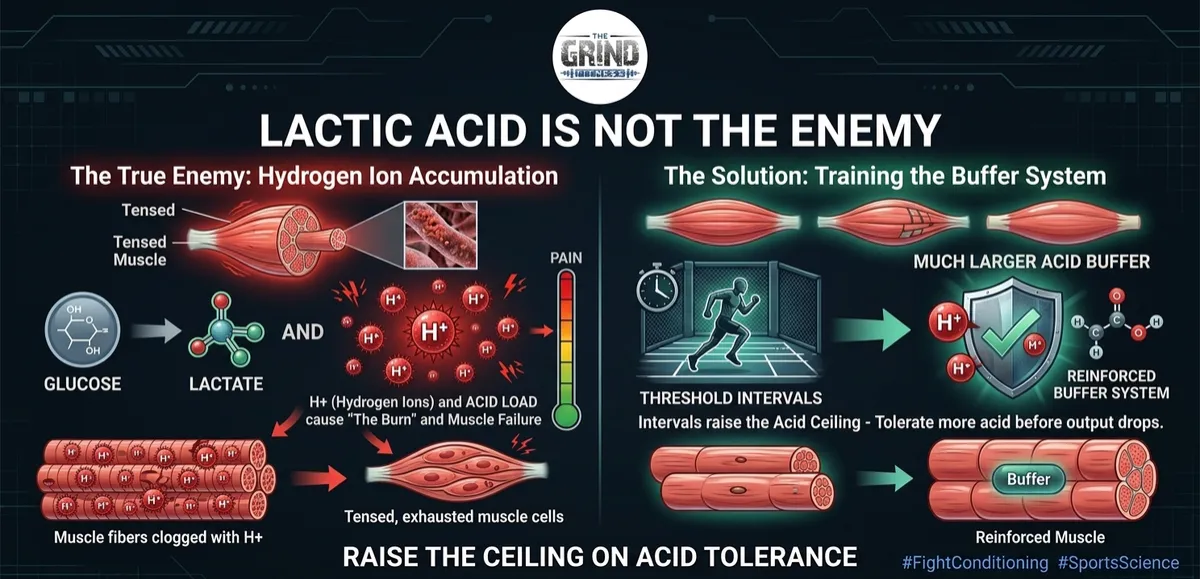
The burn that stops a fighter mid-round is caused by hydrogen ion accumulation. Lactic acid is a compound made of two ions: lactate and hydrogen. Lactate itself is not the enemy. It can actually be reconverted into usable energy and shuttled to other working muscles. The hydrogen ion is what causes the problem. When hydrogen ions accumulate faster than the body can buffer them, muscle pH drops, the internal environment becomes acidic, and force production shuts down.
Understanding this distinction is not just academic. It changes how you train. Because the system that governs how long you can sustain high-intensity output before you hit that wall is trainable. And most combat athletes are not training it.
The Chemistry Behind the Burn
When you push past your aerobic threshold into high-intensity anaerobic work, your body begins producing energy through glycolysis at a rate that far exceeds what the aerobic system can sustain. This process is fast and powerful, which is exactly what combat sports demand. But it comes with a cost.
<cite index="3-1">Lactic acid is a compound made of two ions: lactate and hydrogen. While lactate plays its part in energy production, it is the hydrogen ions that cause discomfort during strenuous activities. An excess of these hydrogen ions reduces the pH level in muscles, leading to the familiar burn that many athletes associate with pushing their physical limits.</cite>
<cite index="5-1">When an athlete crosses the lactate threshold for an extended period of time, acid accumulates in the muscles and can lead to cramping, severely compromising athletic performance. Due to the large amounts of ATP being produced and hydrolyzed in a short period of time, the buffering systems of the tissues are overcome, causing pH to fall and creating a state of acidosis.</cite>
The body has built-in buffering systems designed to neutralize these hydrogen ions and maintain pH within a range that allows continued muscle contraction. Bicarbonate in the bloodstream is the primary extracellular buffer. Carnosine in the muscle cells is the primary intracellular buffer. When these systems are strong and well-trained, the body can sustain higher-intensity output for longer before pH drops to the point where force production becomes impaired.
When they are undertrained, the fighter hits the wall earlier, harder, and with less warning.
Why This Matters More in Combat Sports Than Almost Any Other Sport
<cite index="16-1">MMA fights range from 15 to 25 minutes, with a strong predominance for anaerobic metabolism in high-intensity efforts, with final efforts of repeat sprint protocols still relying heavily on anaerobic energy even as aerobic metabolism increases with each additional round.</cite>
<cite index="18-1">Approximately 77 percent of MMA contests are won by high-intensity actions lasting between 8 and 12 seconds, requiring substantial activation of anaerobic and neuromuscular systems. As combat sports require high-threshold motor unit recruitment in the face of substantial cellular acidosis, training that improves the mechanisms that determine neuromuscular function under these conditions directly benefits combat sport athletes.</cite>
This is the core of the problem for combat athletes specifically. The moments that decide fights, the finishing sequence, the takedown that ends the scramble, the combination that drops an opponent, are almost all happening in the exact physiological window where hydrogen ion accumulation is highest and buffering capacity is most tested. A fighter with a weak buffer system hits his limit before those moments arrive. A fighter with a trained buffer system can still produce maximum output when they do.
<cite index="12-1">The benefit of improved buffering capacity is to raise the anaerobic threshold during activity, allowing combat sports athletes to perform 60-second high-intensity efforts repeatedly for prolonged periods during competition, or when already fatigued. In combat sports such as MMA, BJJ, boxing, and wrestling, performance environments requiring repeated high-intensity efforts with short recovery periods are the norm rather than the exception.</cite>
What the Buffer System Actually Is and How It Works
The buffer system operates through two primary pathways that can both be developed through training.
The extracellular buffer is primarily bicarbonate in the bloodstream. <cite index="9-1">Increasing the bicarbonate concentration and elevating pH in the extracellular space increases the efflux of hydrogen ions from the muscle. Because of the negative consequences of hydrogen ion accumulation within muscle cells, this greater efflux may reduce the fall in muscle cell pH and therefore slow the rate of muscle fatigue development and enhance performance by facilitating enhanced energy supply through anaerobic glycolysis.</cite>
The intracellular buffer is primarily carnosine in the muscle cells. <cite index="9-1">A high rate of anaerobic glycolysis in skeletal muscle during high-intensity exercise can produce hydrogen ions in excess of the intracellular buffering capacity. Supplementation with beta-alanine can increase muscle carnosine content and enhance intracellular buffering capacity, reducing the fall in muscle cell pH during high-intensity exercise.</cite>
Both of these systems can be enhanced through training. <cite index="10-1">Buffer capacity has been reported to be higher in highly trained team-sport athletes, sprinters, and rowers than in marathon runners or untrained subjects, suggesting that athletes involved in sports with a greater anaerobic demand develop a greater buffering capacity through consistent training at the relevant intensities.</cite>
The athletes with the highest buffer capacity are the ones who have consistently trained in the intensity zone that taxes the buffer system specifically. Not below it. Not above it. At it.
How to Train the Buffer System: Threshold Intervals
The training method that most effectively raises buffer capacity is repeated threshold interval work, which means sustained efforts performed at or near the lactate threshold with structured recovery periods designed to allow partial but incomplete clearance between sets.
<cite index="11-1">High-intensity interval training may improve the anaerobic and alactic energy pathway by inducing higher blood lactate peaks, in turn decreasing recovery time through improved lactate clearance and buffering in the muscle cell, leading to lower lactate levels in successive high-intensity efforts. The aerobic and anaerobic adaptations include increased blood pH tolerance and an increase in anaerobic capacity.</cite>
<cite index="19-1">The main purpose of high-intensity training units for MMA athletes is to increase buffering capacity and tolerance to metabolic acidosis. Training protocols that combine maximal strikes and takedowns with maximal isometric intensity, separated by technical work, specifically target these adaptations.</cite>
Practically, threshold intervals for a combat athlete look like this: efforts of 30 to 90 seconds performed at 85 to 95 percent of maximum heart rate, followed by recovery periods of equal to or slightly longer duration, repeated for 4 to 8 rounds. The intensity has to be high enough to genuinely stress the buffer system. Too low and you are building aerobic capacity, which is valuable but different. Too high and you shift into pure anaerobic work where buffer development is not the primary adaptation.
<cite index="14-1">Heart rate has a linear relationship with exercise intensity. Since the lactate threshold represents the switch from aerobic to anaerobic energy production, using an athlete's lactate threshold is a more accurate method of prescribing conditioning work than generic intensity targets. Threshold training for combat athletes can be done through circuit-style work that keeps intensity in the target zone while using sport-specific movements.</cite>
The specific tool matters less than the intensity and duration. Heavy bag rounds maintained at threshold pace, grappling-specific drills kept in the target heart rate zone, bike intervals, sled pushes, and battle ropes all produce the adaptation when the intensity is right. The key is that the effort must be sustained long enough to genuinely stress the hydrogen ion buffering systems, not just spike heart rate briefly and recover.
The Ceiling Rises Over Time
The adaptation produced by consistent threshold interval training is not just that the fighter can go harder before hitting the wall. It is that the wall itself moves.
<cite index="8-1">Training to raise the lactate threshold is one of the primary scientific pathways to accelerate lactate metabolism and eliminate fatigue after high-intensity exercise. When the buffer system is trained consistently at the relevant intensities, the point at which pH drops to a performance-impairing level is pushed progressively higher, meaning the athlete can sustain more output before acid accumulation begins to shut down force production.</cite>
For a combat athlete, this means the rounds where output used to decline now become rounds where output is sustained. The exchanges that used to force a defensive shell now become exchanges where there is still something left to give. The finishing window that used to close before the opportunity arrived now stays open long enough to act on it.
Lactic acid was never the enemy. The buffer system was just never trained to handle what the fight demands of it. Train the buffer system specifically. The ceiling on how much intensity you can sustain before output drops will rise with every week you do.
Want a structured 180-day program that develops every energy system a combat athlete needs to perform at his ceiling? Book a free strategy call with Jairo today.
Sources
Xendurance. Lactate Buffering Guide for Athletes. June 2025. https://xendurance.co.uk/blogs/news/lactate-buffering-guide-for-athletes
Gatorade Sports Science Institute. Buffers and Their Role in the Nutritional Preparation of Athletes. https://www.gssiweb.org/sports-science-exchange/article/sse-124-buffers-and-their-role-in-the-nutritional-preparation-of-athletes
Frontiers in Physiology. Novel Insights into Athlete Physical Recovery Concerning Lactate Metabolism, Lactate Clearance and Fatigue Monitoring. March 2025. https://www.frontiersin.org/journals/physiology/articles/10.3389/fphys.2025.1459717/full
PMC. Effects of High-Intensity Interval Training in Combat Sports: A Systematic Review with Meta-Analysis. https://www.ovid.com/jnls/nsca-jscr/fulltext/10.1519/jsc.0000000000003255
PMC. Effects of High-Intensity Interval Training on Aerobic and Anaerobic Capacity in Olympic Combat Sports: A Systematic Review and Meta-Analysis. May 2025. https://www.ncbi.nlm.nih.gov/pmc/articles/PMC12098572/
MDPI. High-Intensity Conditioning for Combat Athletes: Practical Recommendations. November 2021. https://www.mdpi.com/2076-3417/11/22/10658
PMC. The Effects of Conditioning Training on Body Build, Aerobic and Anaerobic Performance in Elite Mixed Martial Arts Athletes. https://pmc.ncbi.nlm.nih.gov/articles/PMC6942465/
PMC. Performance Metrics of Anaerobic Power in Professional Mixed Martial Arts Fighters. 2025. https://pmc.ncbi.nlm.nih.gov/articles/PMC12452388/
GC Performance Training. MMA Strength and Conditioning: Endurance and Energy System Training for MMA. https://gcperformancetraining.com/gc-blog/mmastrengthconditioning2
Myprotein. Best Supplements for Combat Sports: Boxing, MMA, Wrestling and More. May 2026. https://www.myprotein.com/thezone/training/combat-sports-the-best-supplements-for-boxing-mma-martial-arts-more/
