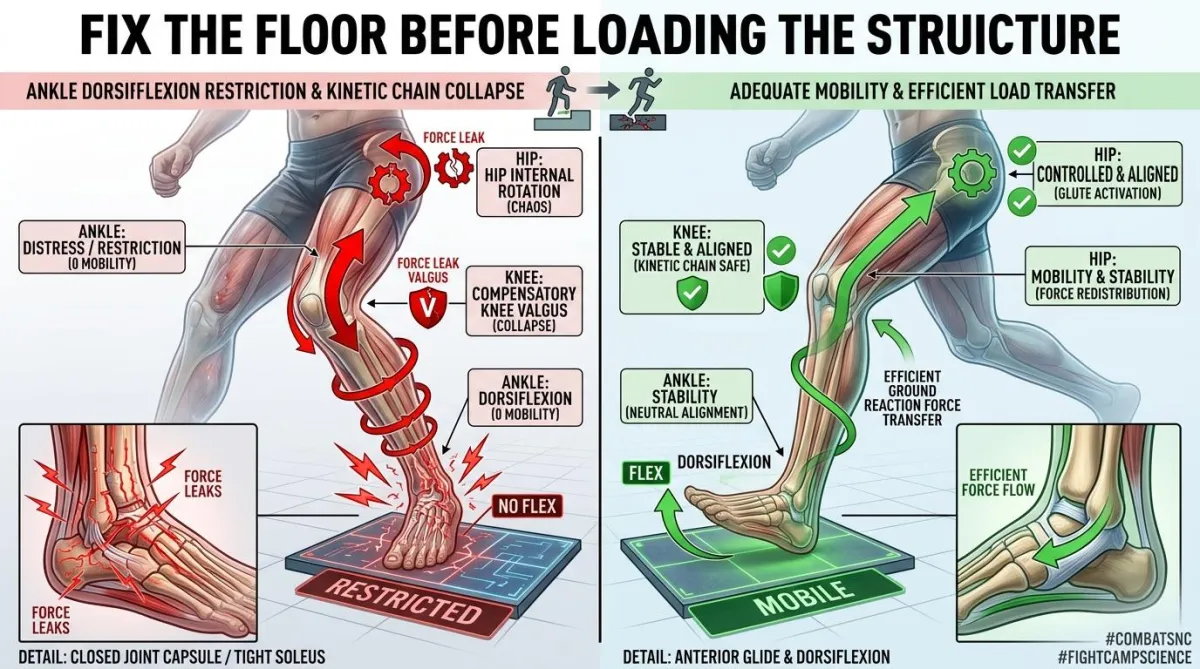
Fix the Ankle First. Everything Above It Depends on It
By Jairo Morales | Train Like a Combat Athlete
When a combat athlete's knee caves inward during a level change, most coaches look at the knee. When his hips collapse during a takedown entry, most coaches look at the hips. When his explosive push-off leaks force on every lateral movement, most coaches add more hip strengthening work and wonder why nothing changes.
The problem is almost never where it appears. It starts at the ankle.
Ankle dorsiflexion restriction under load is one of the most common and most overlooked structural limitations in combat sports athletes. It is common because the ankle is chronically under-mobilized in training programs that emphasize strength and conditioning without addressing the joint range of motion those qualities require to express themselves correctly. It is overlooked because the compensation it produces does not show up at the ankle. It shows up three joints higher, at the knee and the hip, where coaches are looking for the problem that actually started at the floor.
What Ankle Dorsiflexion Is and Why It Matters Under Load
Dorsiflexion is the movement of the foot toward the shin. It is the range of motion that allows the tibia to travel forward over the foot during any movement that involves knee flexion, which means squatting, lunging, level changing, cutting, and every explosive push-off a combat athlete performs in training and competition.
When adequate dorsiflexion range is available, the tibia can travel forward in the sagittal plane, meaning straight ahead, and the forces of the movement are distributed correctly through the kinetic chain. The foot stays neutral, the knee tracks over the toes, and the hip maintains its alignment.
When dorsiflexion is restricted, the tibia cannot travel far enough forward in the sagittal plane. The body still needs to complete the movement, so it finds range of motion somewhere else. <cite index="3-1">With restricted dorsiflexion, the body compensates for this lack of range in the sagittal plane with movement in the frontal or transverse plane throughout the kinetic chain. This compensation comes from pronation of the foot, internal rotation of the tibia, internal hip rotation and adduction, or pelvic drop, creating dynamic knee valgus.</cite>
The ankle restriction does not disappear. It gets borrowed against, and the cost of that borrowing is paid by the structures above it.
The Chain of Force Leaks
The compensation pattern produced by ankle dorsiflexion restriction follows a predictable sequence that every combat athlete with this limitation is running through on every level change, every push-off, and every explosive lower-body movement in his training.
The foot pronates inward to create extra range at the subtalar joint. The tibia internally rotates as a consequence of that pronation. <cite index="6-1">Restricted ankle joint dorsiflexion directly results in overpronation of the foot, which causes internal rotation of the lower extremity, which strains the external and abductor musculature, which can then no longer maintain correct frontal plane alignment at the knee.</cite> The knee collapses into valgus, meaning it caves inward toward the midline. The hip follows with internal rotation and adduction as the pelvis attempts to compensate for the loss of alignment below it.
<cite index="5-1">Reduced ankle dorsiflexion range of motion is associated with an increase in adduction of the hip during functional loading tests, with participants showing equal to or less than 17 degrees of dorsiflexion displaying greater dynamic hip adduction compared to those with greater available range.</cite>
This is not a minor mechanical inefficiency. Every joint that is forced out of its optimal alignment during a high-force movement is a joint that is absorbing stress it was not designed to handle and producing force at a mechanical disadvantage. The knee in valgus is loading the medial structures asymmetrically. The hip in internal rotation is inhibiting the glutes from producing full force output. The entire posterior chain, which is responsible for explosive hip extension in a takedown, a punch, or a push-off, is compromised from the ground up because the ankle is restricting what the joints above it can do.
One mobility limitation at the ankle creates a cascade of force leaks that show up three joints higher and rob the athlete of power he is working hard in the gym to develop.
What This Looks Like in Combat Sports
The practical manifestation of this compensation pattern in a combat athlete is specific and shows up in movements that are central to his sport.
A wrestler level-changing into a takedown with restricted dorsiflexion will show knee cave and hip internal rotation at the bottom of his level change. His entry looks hesitant or structurally weak even when the timing is correct, because the joints driving the movement are not in the positions that allow them to produce maximum force.
A grappler pushing off the mat to recover guard or scramble to his feet will leak force through every push-off because the ankle cannot dorsiflex adequately to allow the tibia to travel forward cleanly, forcing the foot to pronate and the knee to track incorrectly on every rep.
A striker cutting angles and resetting position will show reduced explosiveness and lateral agility because the ankle restriction is forcing compensatory patterns into every direction change, adding mechanical cost to movements that should be efficient and direct.
The athlete feels this as a limitation in explosiveness, a weakness in certain positions, or a tightness in the knees and hips that hip stretching never seems to fully resolve. The hip is not the problem. The hip is where the problem from the ankle is showing up.
Fix the Floor Before Loading the Structure
The principle that matters here is straightforward: the foundation determines what can be built on top of it. A restricted ankle is a compromised foundation. Squatting, lunging, sprinting, and loading explosive movements on top of a restricted ankle does not build the athlete. It loads the compensation pattern with increasing weight and intensity until something fails.
<cite index="2-1">Individuals with less ankle dorsiflexion range of motion are more likely to experience high degrees of knee valgus, and restriction of dorsiflexion range of motion may engage forces toward compensation for excessive foot pronation, internal tibia rotation, adduction, hip internal rotation, and pelvic drop, leading to a full dynamic knee valgus pattern.</cite>
The fix starts at the ankle, not at the knee or the hip. Mobilizing the ankle before addressing the compensatory patterns above it is the correct sequence because it removes the restriction that is driving those patterns in the first place. Hip strengthening done before the ankle can dorsiflex adequately trains the hip to produce force in a compensated position, which is a different adaptation than training the hip to produce force from correct alignment.
Practical tools for restoring ankle dorsiflexion range include banded ankle mobilizations targeting posterior talar glide, which addresses the most common mechanical restriction at the ankle joint itself. Wall ankle mobilizations with a knee-over-toe bias, performed for sets of 10 to 15 repetitions with a 2 to 3 second hold at end range, progressively restore the available sagittal plane range over time.
Calf and soleus flexibility work, specifically targeting the gastrocnemius with a straight-knee stretch and the soleus with a bent-knee stretch, addresses the soft tissue component of the restriction. The soleus stretch is often more relevant for athletes because the soleus is the primary limiter of dorsiflexion under a flexed knee load, which is the position every combat-relevant movement occurs in.
Once range has been restored, it must be reinforced under load. Goblet squats performed with deliberate knee-over-toe tracking and a narrow stance require the newly available dorsiflexion range to be used under compressive load. Slant board squats provide a consistent dorsiflexion demand that progressively loads the range in a controlled way. These are not exercises designed to make the athlete stronger in the traditional sense. They are designed to own the range that mobility work opened up so it transfers to the movement patterns that matter.
The Bottom Line
Force leaks at the hip and knee are not always hip and knee problems. When the foundation is restricted, the structure above it compensates. When the ankle cannot dorsiflex adequately under load, the knee, the hip, and the entire posterior chain are being asked to produce force from positions they were not designed to sustain.
Fix the floor first. Restore the ankle range. Reinforce it under load. Then build strength and power on top of a foundation that can actually support it.
The athlete who addresses the ankle before loading the structure above it does not just move better. He is stronger, more explosive, and less injured because the force he is producing is no longer leaking out of every joint between the ground and his hips.
Want a structured 180-day program that addresses mobility, strength, power, and athletic performance in the correct sequence for combat sports? Book a free strategy call with Jairo today.
Sources
Learnmuscles.com. Decreased Ankle Dorsiflexion is Associated with Dynamic Knee Valgus. July 2026. https://learnmuscles.com/blog/2026/07/30/decreased-ankle-dorsiflexion-is-associated-with-dynamic-knee-valgus/
ResearchGate. Relationship of hip and ankle range of motion, trunk muscle endurance with knee valgus and dynamic balance in males. October 2018. https://www.researchgate.net/publication/328296923
ResearchGate. The effect of ankle dorsiflexion range of motion in dynamic knee valgus: A systematic review. February 2016. https://www.researchgate.net/publication/296064017
ScienceDirect. The association of ankle dorsiflexion and dynamic knee valgus: A systematic review and meta-analysis. July 2017. https://www.sciencedirect.com/science/article/pii/S1466853X16301614
ScienceDirect. The association between loss of ankle dorsiflexion range of movement, and hip adduction and internal rotation during a step down test. September 2015. https://www.sciencedirect.com/science/article/abs/pii/S1356689X15001848
ResearchGate. The Association Between Loss of Ankle Dorsiflexion Range of Movement, and Hip Adduction and Internal Rotation During a Step Down Test. October 2024. https://www.researchgate.net/publication/282006729
PMC. The Ripple Effect: How Hallux Valgus Deformity Influences Ankle and Knee Joint Kinematics During Gait. 2026. https://www.ncbi.nlm.nih.gov/pmc/articles/PMC12292415/
